














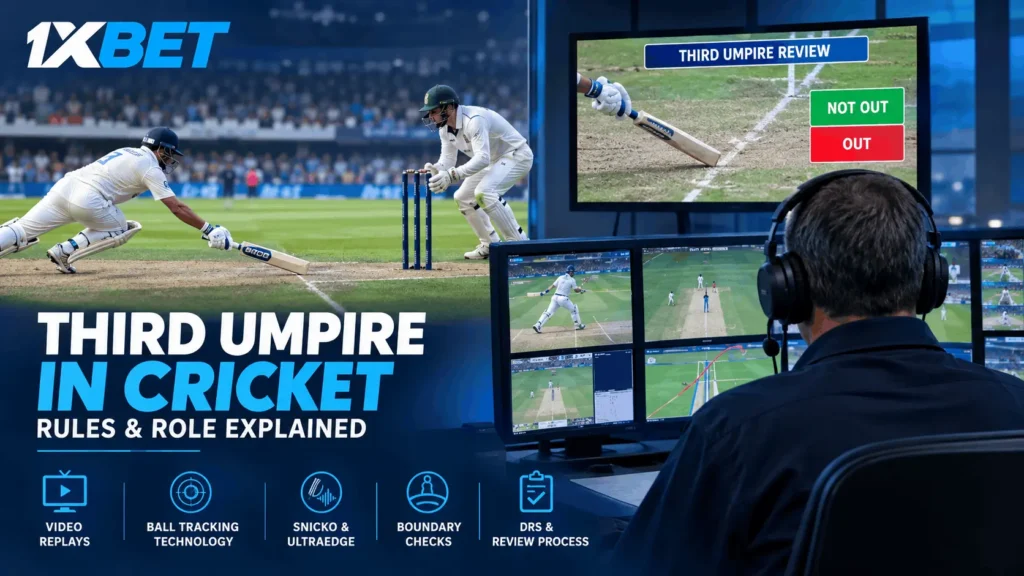
The bowler appeals, the batter stays rooted to the crease & the stadium simply waits. Then the big screen flashes the replay & everyone holds their breath. At 1xBet India, we all know that this is one of the most gripping moments in cricket & subsequently it is all in the hands of the third umpire in cricket.
The third umpire is an off-field official who uses TV replays & technology in order to help the on-field umpires for reaching accurate decisions. This guide covers the rules, the process & much more, so that you can follow every review with confidence.

What Is the Third Umpire in Cricket?
The third umpire is a match official who sits in a monitoring room away from the pitch. In addition, this official has direct access to broadcast replays from multiple camera angles & ball tracking tools.
Key facts at a glance:
- Role: Reviews close decisions using video evidence.
- Location: Off the field, in the broadcast or in the control room.
- Used in: Test matches, ODIs & T20Is, along with major leagues that follow ICC style protocols.
- Authority: Advises or simply decides on the referred call & passes it to the on-field umpire.
- Goal: To reduce human error & keep the game fair.
Technology first entered international cricket in 1992. Moreover, the third umpire gave a decision in a Test match between South Africa & India at Durban, when Sachin Tendulkar has became the first batter who was dismissed through a TV replay. Since then, the role has grown into a core part of modern cricket rules.
Third Umpire in Cricket Explained: Roles and Responsibilities
The third umpire does not review every ball. The role is limited to specific situations, and knowing them makes live matches easier to follow.
Common decisions handled by the third umpire:
- Run outs and stumpings: Checking whether the bat or foot was grounded behind the line
- Boundary calls: Confirming fours, sixes and whether a fielder touched the rope
- Catches: Verifying clean catches, especially close to the ground
- No balls: Checking front foot overstepping by the bowler
- Hit wicket: Confirming whether the batter disturbed the stumps
- Disputed dismissals: Reviewing evidence when a player challenges the call
Two ways a review begins:
- On field referral: The umpires on the ground send a doubtful decision upstairs
- Player review: A captain or batter uses the Decision Review System to challenge a call
If you want a deeper look at the challenge system, our guide on DRS in Cricket breaks it down. For dismissal-specific rules, you can also read our blogs on Run Out in Cricket and Stumping in Cricket on 1xbetind.com.
Explore More: 1xbetind-Declaration in Cricket: Rules, Examples and Key Facts
How Third Umpire in Cricket Works: The Review Process
Understanding how the third umpire in cricket works makes the waiting time far less confusing. Now, we will discuss the usual order of events:
- Request: The on-field umpire signals a TV replay, or a team simply asks for a review
- Feed access: The third umpire receives live and recorded footage from the broadcast
- Replay checks: Multiple angles are studied in slow motion and frame by frame
- Technology tools: Where available, Snicko, Hot Spot & Hawk-Eye add extra evidence
- Decision: In addition, the third umpire communicates the verdict to the on-field umpire
- Big screen display: The result is shown, with green for not out and red for out
Tools commonly used during reviews:
- Slow motion replays: Show contact between bat, ball, pad or ground
- Snicko or UltraEdge: Detect faint sounds to check for edges
- Hot Spot: Uses thermal imaging to show where the ball made contact
- Hawk-Eye: Tracks and predicts ball trajectory, mainly for leg before wicket reviews
For run outs, the third umpire usually checks the exact frame in which the bat or foot first grounds behind the crease. This frame by frame method is what makes a decision look so accurate on screen.
Key Rules & Protocols Every Cricket Fan Should Know
Several protocols shape how the third umpire reaches a final call. Moreover, these are worth knowing if you follow match analysis or track live scores.
- Benefit of the doubt: If the evidence is not conclusive, the batter is usually given the benefit
- Umpire’s call: On ball tracking reviews, the original on-field decision stays if the ball is only clipping the stumps
- Order of checks: In some dismissals, the third umpire first checks for a no ball before looking at the wicket
- Limited reviews: Each team gets a set number of unsuccessful reviews per innings, which genereally differs by format
- Format differences: Playing conditions can vary across Tests, ODIs and T20Is, so it is wise to check the latest ICC playing conditions before a series
However, these rules come from the MCC Laws of Cricket & the ICC playing conditions, which are the main references for official match procedure.
Real Match Examples of Third Umpire Decisions
In this section we will discuss few examples that shows why this role matters so much in player performance & match results.
Example 1: The first ever third umpire dismissal
- Match: South Africa vs India, Durban, 1992
- What happened: Sachin Tendulkar was being sent upstairs for a run-out appeal
- Result: He became the first batter given out by a third umpire
- Why it matters: It marked the start of technology-assisted umpiring in international cricket
Example 2: A typical run out review (illustrative scenario)
- Situation: A batter dives for the crease while the fielder breaks the stumps
- Review: The third umpire simply checks the frame where the bat touches the ground
- Outcome: If the bat is behind the line, the batter stays & a possible century is being saved
Example 3: A typical boundary review (illustrative scenario)
- Situation: A fielder catches the ball near the rope & steps close to the boundary
- Review: The replay shows whether the fielder has touched the rope while holding the ball
- Outcome: A six, a catch or a fielding save is confirmed with evidence
Decisions like these can simply change a batter’s score, a bowler’s figures & the final result in a single replay.
Why the Third Umpire Matters for Fans & Match Analysis
For fans who follow cricket closely, the third umpire subsequently adds clarity & trust to every match. This is why 1xBet India treats rule explainers like this as an important part of our cricket content.
How it helps you:
- Better understanding: You can follow live decisions without confusion
- Fairer outcomes: Fewer wrong calls mean results that reflect real performance
- Reliable statistics: Accurate dismissals and boundaries keep sports statistics clean and trustworthy
- Smarter match analysis: Knowing the review process helps you judge momentum shifts after a big decision
- Stronger cricket knowledge: Familiarity with cricket terminology makes commentary easier in order to follow.
Read More: 1xbetind-DRS in Cricket: Rules, Examples and Key Facts
Common Misconceptions About the Third Umpire
A few myths still confuse most of the viewers. Here is the reality:
- Myth: The third umpire makes every decision in the match
Fact: The on-field umpires make most calls & the third umpire steps in only for specific reviews - Myth: Technology is always 100 percent accurate
Fact: Tools have margins of error, which is why the umpire’s call exists - Myth: The third umpire can review anything at any time
Fact: Reviews follow strict rules & are limited to defined situations
Conclusion
To conclude, we have discussed that the third umpire in cricket brings accuracy, fairness & transparency to the modern game. From run-outs to boundary checks, this role helps simply decide moments that can shape an entire match. With this guide, you know the rules, the review process & the tools involved eventhough every replay becomes easier in order to follow. In addition, you can keep exploring more cricket rules guides and match insights with 1xBet India & stay ahead of every decision on the field.