














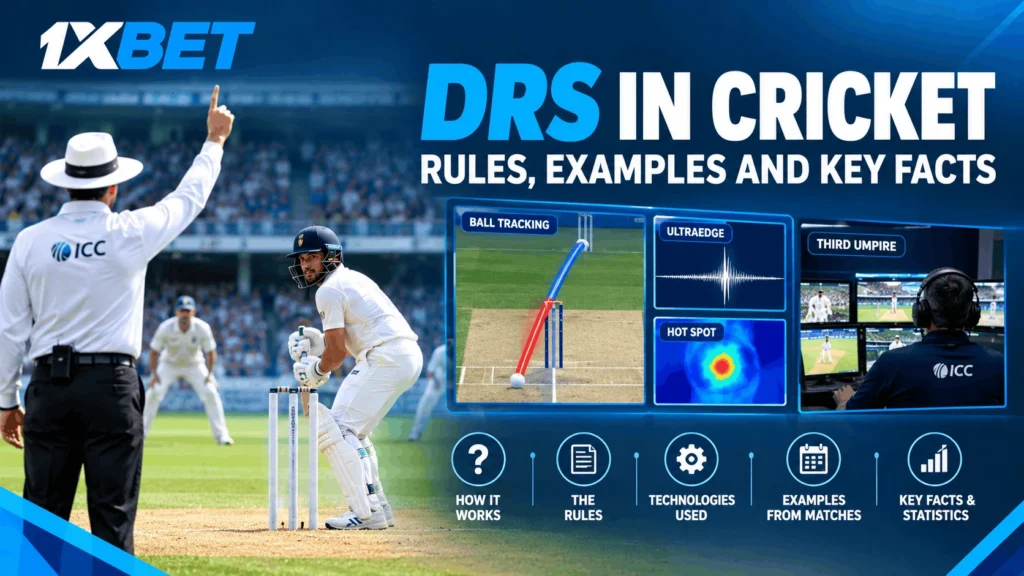
The batter hesitates. The bowler appeals with full confidence. The umpire raises his finger & the batter responds with the T signal. For the next few seconds, the stadium & millions of viewers at home wait on one replay. Moreover, this is DRS in cricket, a technology-based system that lets teams challenge on-field decisions.
At 1xBet India, we help cricket fans understand the game beyond the scorecard & few topics shape modern matches as much as DRS. This guide covers how DRS in cricket works, the rules, the tools & much more.

Overview of DRS in Cricket
DRS means Decision Review System. Moreover, it allows a team in order to challenge an umpire’s decision, which is then checked by the third umpire using replays & tracking technology.
- Its purpose is to correct clear umpiring errors, not to just replace the on-field umpires.
- This is being used in Tests, ODIs, T20Is & major leagues such as the IPL
- The batter, or the fielding captain, can review on behalf of the bowling side
- Typical decisions reviewed are LBW, caught behind, bat pad catches & run outs
- It was first used in Tests in 2008, with wider adoption across formats in the years that followed
For readers who are building their cricket terminology, you need to remember that the on-field umpire always makes the first call. Therefore, DRS only steps in when a team challenges it.
How DRS in Cricket Works: Step-by-Step Process
- The on-field umpire gives a decision, either out or not out.
- The batter or fielding captain signals for a review within 15 seconds.
- The on-field umpire makes the T signal & refers the decision to the third umpire.
- The third umpire checks the available tools in a set order, starting with replays, then edge detection & ball tracking.
- The third umpire advises the on-field umpire, who confirms or changes the decision.
- The review count is updated according to the outcome.
In addition, players cannot take advice from the dressing room & the review must come from the players on the field. In some tournaments, including the IPL, teams can even review decisions on wides & no-balls.
Technologies Used in DRS: Ball Tracking, UltraEdge & Hot Spot
DRS is not one tool. It is a combination of technologies, each built for a specific type of decision.
- Ball tracking (Hawk Eye): It records the ball’s path and projects where it would have travelled. It is mainly used for LBW in order to check the pitching point, the point of impact & whether the ball would hit the stumps.
- UltraEdge: A sensitive microphone near the stumps records sound. Moreover, a spike on the graph as the ball passes the bat helps confirm a thin edge.
- Hot Spot: Infrared cameras highlight heat marks where the ball made contact. It is used only in some series because of its cost.
- Slow motion replays: Close-up angles help in run outs, stumpings & boundary catches.
Ball tracking is a projection, so it carries a small margin of error. That margin is the reason the Umpire’s Call rule exists.
DRS Rules in Cricket: Reviews, Umpire’s Call and Limits
The DRS rules in cricket are set by the ICC and the event organisers, and they differ slightly by format.
- Reviews per innings:
- Tests: 2 unsuccessful reviews per innings
- ODIs and T20Is: 1 unsuccessful review per innings
- IPL: 2 reviews per innings under tournament rules
- Successful reviews are retained. A team loses a review only when the original decision stays.
- Umpire’s Call: If ball tracking shows the ball only clipping the stumps, or the margin is too close, the on-field decision stays. Moreover, the team keeps its review in this case.
- Time limit: A review request after the 15-second window is rejected.
- Not reviewable: Decisions outside the scope of the playing conditions, such as a player’s conduct or a bad light call.
In addition, you have to review numbers & conditions can change between series, so you need to always check the latest ICC playing conditions before analysing a match.
DRS in Cricket Examples: Reviews That Became Talking Points
Real match moments show why DRS is both a tool & a test of judgment.
- Steve Smith, Bengaluru Test, 2017: After being given LBW, Smith looked toward his dressing room before deciding on a review. The umpire denied the review, which started a global debate on DRS conduct. Smith later described it as a brain fade.
- The “Dhoni Review System”: Indian fans jokingly said that DRS meant Dhoni Review System because MS Dhoni’s instincts on whether to review often matched the replay. Moreover, it highlights how player performance & captaincy awareness shape your review decisions.
- A common match scenario: A close LBW simply shows the ball clipping the top of the stump. However, the decision stays not out & the bowling side keeps its review. That is Umpire’s Call in action.
For deeper match analysis, you can simply check official scorecards & match highlights for any review you want to study.
Explore More: 1xbetind-Betting App Cricket – Cricket Markets and Betting Features
DRS in Cricket Statistics & Accuracy
DRS has had a clear effect on decision quality at the top level.
- The ICC has reported that overall decision accuracy improved noticeably after DRS became widely used, from the low nineties to the high nineties in percentage terms.
- Review success rates differ across formats, teams & conditions.
- Moreover, captains who review selectively tend to keep their reviews for critical moments.
- Likewise, tracking sports statistics such as successful reviews per match adds a deeper layer to your understanding of how teams manage pressure.
How DRS in Cricket Helps Fans Follow the Game Better
Knowing DRS changes how you watch a match. At 1xBet India, we believe informed fans enjoy cricket more & DRS knowledge is part of that.
- You can follow turning points with more confidence.
- You can even judge whether a captain used a review wisely or wastefully.
- You understand why a decision stayed even when the replay looked close.
- Moreover, you can simply compare player performance & team decisions across formats.
- In addition, you add depth to every conversation about cricket rules, from Tests to the IPL.
Whether you are following a Test, an ODI or a T20 night, this understanding helps you read the momentum of the game.
Conclusion
In the above blog, we have discussed how DRS in cricket works, from the T signal to the third umpire’s final verdict. You have seen the technology, the rules, the Umpire’s Call & real moments that shaped matches. Moreover, the next time a close appeal comes up, you will know exactly what to watch for on the replay. In addition, you need to keep exploring more cricket rules guides on 1xBet India in order to build your match understanding & follow every format with confidence.