














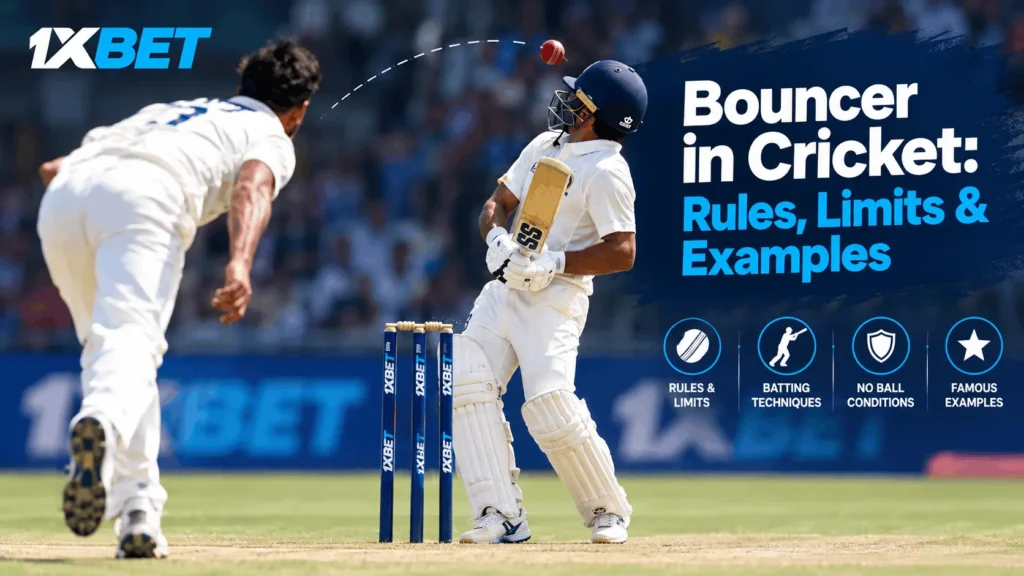
A fast bowler runs in, the ball is released at more than 140 km/h, & within a fraction of a second it rises sharply towards the batter’s head. The batter must decide whether to duck, sway or attack. Moreover, that single decision can simply change the course of an innings, and for Indian cricket followers, it is a scene that appears in nearly every major Test series overseas. At 1xBet India, we believe that understanding the rules behind such moments leads to a far better appreciation of the game.
In addition, a bouncer in cricket is a fast, short-pitched delivery that passes above the batter’s shoulder height. This guide explains the laws that govern it, the limits applied in each format, notable examples from cricket history & much more.

What Is a Bouncer in Cricket?
A bouncer is a delivery pitched short of a good length, causing the ball to bounce steeply and rise above the shoulder of a batter standing upright at the crease. It is also known as a bumper or a short ball.
- Purpose: Bowlers use it to create uncertainty, disturb the batter’s footwork & induce a false shot.
- Role of pace: The delivery is most effective at high speed, which is why most of the fast bowlers use it more often than spinners.
- Legal but regulated: The bouncer is a legitimate part of the game, although the laws limit how frequently it may be bowled.
Likewise, familiarity with this basic cricket terminology simply makes commentary, scorecards & match reports easier in order to interpret.
Bouncer Rules in Cricket: Over Limits & No Ball Conditions
The regulation of short-pitched bowling is based on the MCC Laws of Cricket & the ICC Playing Conditions. Moreover, these rules protect batters while preserving a fair contest between bat and ball.
- Shoulder height test: The umpire determines whether the ball would pass above the shoulder of a batter standing upright in the crease.
- Over limit: If a bowler exceeds the permitted number of bouncers in an over, the umpire simply signals a no ball.
- Wide ball in limited overs: In white ball formats, a delivery passing above the batter’s head may be called a wide.
- Dangerous bowling: Umpires may issue warnings for repeated or intimidatory short-pitched deliveries & continued offences can lead to the bowler being removed from the attack.
Explore More: 1xbetind-Boundary Count in Cricket: Rules, Examples and Key Facts
The typical limits are summarised below:
| Format | Bouncers allowed per over | Penalty for exceeding |
| Test cricket | 2 | No ball |
| ODI | 2 | No ball |
| T20I | 1 | No ball |
In addition, playing conditions are being eviewed periodically, so readers should verify the latest ICC regulations for any specific tournament.
How a Bouncer in Cricket Works: Bowler’s Plan vs Batter’s Response
Understanding how a bouncer in cricket works requires an examination of both sides of the contest.
- The bowler’s plan
- Field placement: Captains often position fielders at fine leg, deep square leg or in catching positions in order to capitalise on a mistimed pull or hook.
- Element of surprise: A short ball after a sequence of fuller deliveries can subsequently disrupt the batter’s rhythm.
- Pitch conditions: Surfaces with extra bounce, such as those in Australia and South Africa, increase the effectiveness of the delivery.
- The batter’s response
- Duck or sway: The safest option, allowing the ball to pass without risk.
- Hook or pull: A high-risk shot that can result in a boundary or a catch in the deep.
- Upper cut: A common option against a bouncer directed outside the off stump.
Safety measures have improved significantly. Helmets with grills are now standard equipment, and the concussion substitute rule provides additional protection to players.
Famous Bouncer Examples in Cricket
The bouncer has played a defining role in cricket history & several moments illustrate its influence which we have discussed below:
- Bodyline series, 1932 to 33: England’s use of aggressive short bowling against Australia generated major controversy & even led to changes in the laws.
- West Indies pace attack: Bowlers such as Michael Holding & Malcolm Marshall simply established the short ball as being a central weapon during the 1970s & 1980s.
- Modern pace bowling: Shoaib Akhtar & Dale Steyn combined extreme pace with sharp bounce for challenging the best batters of their eras.
- Indian fast bowling: Jasprit Bumrah & Mohammed Shami use the short ball selectively, relying on timing & planning more than aggression alone.
Therefore, these examples demonstrate that an effective bouncer generally depends on skill, accuracy & judgement as much as on speed.
Bouncer in Cricket and Player Performance: What the Statistics Show
Short-pitched bowling is a reliable measure of player performance. Moreover, analysts study how batters respond to it using sports statistics such as strike rate, dismissal types & scoring zones.
- Dismissal patterns: Wickets from bouncers frequently come through top edges, catches at fine leg or deep square leg & even mistimed hook shots.
- Scoring rates: Batters with a strong pull & hook can consequently score quickly against short bowling, while others may struggle in order to rotate the strike.
- Match situations: A bouncer plan is most effective against a new batter or on a pitch with uneven bounce.
In addition, careful match analysis reveals which batters handle the short ball with confidence & which ones are vulnerable to it.
Why Understanding the Bouncer Improves Your View of Live Cricket
For readers of 1xBet India, a clear grasp of the bouncer rule supports a more informed reading of live matches.
- Identify momentum shifts: A sudden spell of short bowling often indicates a captain’s attempt in order to break a partnership.
- Interpret umpire decisions: You will simply understand immediately why a no ball or wide has been signalled.
- Follow tactical changes: Field adjustments before a short delivery reveal the bowler’s intended plan.
Visit our cricket rules section for more detailed explainers on laws and match situations. Moreover, this content is intended for information only. Users must be 18 years or older in order to access any betting service & should act responsibly in accordance with the laws applicable in their state.
Read More: 1xbetind-LBW in Cricket: Rules, Examples and Key Facts
Conclusion
In the above blog, we have discussed that the bouncer in cricket remains one of the most strategic & closely regulated deliveries in the sport. It simply combines pace, precision & tactical planning, while the laws ensure that the contest stays fair and safe for every player. Knowledge of the shoulder height rule, the over limits in each format & the historical examples discussed above allows followers in order to interpret match situations with greater accuracy.
Whether the game is a Test match, an ODI or a T20 fixture, each short-pitched delivery carries tactical meaning that becomes clearer with understanding. In addition, you need to continue building that understanding with 1xBet India, & subsequently explore our other cricket rules guides for reliable, well-researched explanations of the game.