












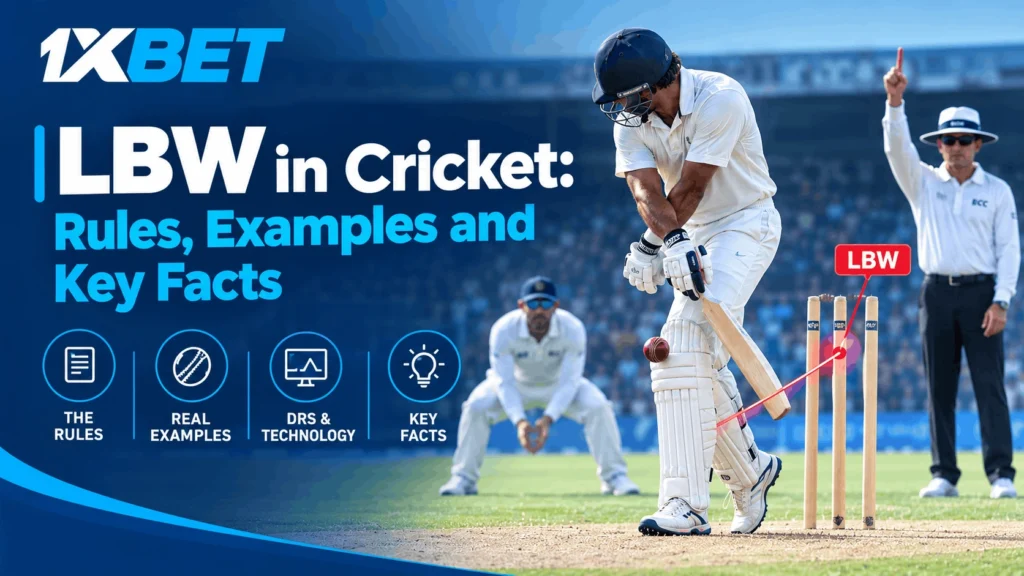
The bowler appeals, the ball has struck the batter’s pad, and the entire stadium waits for the umpire. One raised finger can change the course of a match. This is LBW in cricket, the dismissal that creates the most debate among players, commentators & fans.
At 1xBet India, we believe that understanding cricket rules makes every match more engaging in order to follow. LBW (Leg Before Wicket) is a dismissal where the batter is given out because the ball struck their body instead of the bat & would have gone on to hit the stumps. Therefore, this guide from 1xBet India explains how LBW in cricket works, covers the exact conditions under Law 36, walks through DRS reviews & clears up the most common myths.

What Is LBW in Cricket?
- LBW is a mode of dismissal defined under Law 36 of the MCC Laws of Cricket
- The rule exists to stop batters from using their pads as a second bat to protect the stumps
- Without this law, a batter could simply block every delivery with the legs and never risk getting out
- A batter is out LBW only when all of the following conditions are met:
- The delivery is legal (not a no ball)
- The ball pitches in line with the stumps or on the off side
- The ball strikes the batter before touching the bat
- The impact is in line with the stumps, with one exception explained below
- The ball would have gone on to hit the stumps
If even one of these conditions fails, the batter is not out. This is why many appeals that look convincing on the field are turned down.
LBW in Cricket Explained: The Rules Step by Step
Umpires work through a four-question test in a matter of seconds. Here is how each part works.
1. Where Did the Ball Pitch?
- In line with the stumps or outside off stump: the appeal stays valid
- Outside leg stump: the batter is never out LBW, regardless of where the ball hits afterwards
- Moreover, this is the first check because it eliminates a large number of appeals immediately
2. Where Did the Ball Hit the Batter?
- If the batter was playing a shot, the impact can be outside off stump & the batter can still be given out.
- If the batter was not offering a shot, the impact must be in line with the stumps.
- Likewise, an impact outside leg stump is never out.
- A shot is considered offered when the batter makes a genuine attempt in order to hit the ball with the bat.
3. Did the Bat or Glove Touch the Ball First?
- If the ball touches the bat or the glove holding the bat before the pad, the dismissal cannot be LBW.
- This is the reason UltraEdge or Snicko is checked in many reviews.
- In addition, a thin inside edge can save a batter even when the ball goes on to strike the pad cleanly.
4. Would the Ball Have Hit the Stumps?
- The umpire must predict the path of the ball after it hits the batter.
- Factors such as swing, seam movement, spin & bounce all play a part in this judgement.
- Moreover, a ball that would have gone over the top or missed the stumps is not out.
- This is the part of the law that creates the most disagreement, because it relies on prediction rather than a visible outcome.
How LBW in Cricket Works With DRS and Ball Tracking
The Decision Review System (DRS) gives teams a chance to challenge on-field decisions. For an LBW review, technology checks three things in order:
- Pitching: where the ball landed
- Impact: where the ball struck the batter
- Wickets: whether the ball was going on to hit the stumps
Ball tracking technology such as Hawk-Eye builds a projected path from the data & the third umpire uses it along with replays to confirm or overturn the decision.
What Does “Umpire’s Call” Mean?
- It appears when the ball is only clipping the stumps or the impact is marginal
- It does not mean the umpire made a mistake; it means there is not enough evidence to overturn the original decision
- If the on-field call was out, it stays out. If it was not out, it stays not out
- A team does not lose a review when the result is Umpire’s Call on the wicket check
Quick tip: When you see the tracking graphic on TV, look at the three zones for pitching, impact & wickets. Moreover, a flashing or amber marker on any zone points to Umpire’s Call.
LBW in Cricket Examples You Can Picture
These scenarios help you test your understanding the next time you follow a match.
- Example 1: Out. A fast bowler pitches the ball on middle stump. It hits the batter’s front pad in line, and tracking shows it striking the top of off stump. The batter is out.
- Example 2: Not out, pitched outside leg. A spinner bowls a delivery that lands outside leg stump and turns in sharply. It hits the pad in front of the stumps. The batter is not out because the ball pitched outside leg.
- Example 3: Not out, bat first. The ball takes a thin edge and then hits the pad. The appeal is loud, but the bat made contact first. The batter is not out.
- Example 4: Out, impact outside off. The batter plays a shot at a swinging ball and misses. The ball strikes the pad outside off stump but would have hit the stumps. The batter is out because a shot was offered.
- Example 5: Not out, no shot offered. The batter pulls the bat away & the ball hits the pad outside off stump. Since no shot was played, the batter is not out.
- Example 6: Umpire’s Call. Tracking shows only a small portion of the ball clipping the bails. The on-field decision stands.
Key LBW Facts Every Cricket Fan Should Know
- DRS was first used in a Test series in 2008, during India’s tour of Sri Lanka.
- DRS was introduced in the IPL in 2018, which is why Indian fans now see reviews in most matches.
- A batter cannot be out LBW off a no-ball.
- Moreover, a batter cannot be out LBW on a free hit.
- Swing and spin bowlers often create more LBW chances, because the ball changes its path after pitching.
- Familiarity with cricket terminology such as “plumb”, “front foot”, “impact” and “Umpire’s Call” makes commentary far easier to follow.
- In addition, tracking only predicts the ball’s path, so it is a strong aid for umpires & not a perfect replacement for judgement.
Why LBW Matters in Match Analysis and Player Performance
LBW decisions often decide the momentum of a match. That is why serious followers pay attention to them.
- Bowlers: A high number of LBW dismissals usually points to strong control of line, length & movement
- Batters: Repeated LBW dismissals can highlight a technical issue, such as playing across the line or committing early to the front foot
- Match situations: An LBW early in an innings can expose a team to pressure, while a successful review can swing a close game
- Statistics: Dismissal types are an important part of sports statistics & they help fans compare players on more than just runs and wickets
In addition, following these details through 1xBet India helps you read the game with more context & less guesswork.
Common LBW Myths in Cricket
- Myth: “If the ball hits the pad outside off stump, it is never out.”
Fact: If the batter was playing a shot, it can still be out. - Myth: “The ball must hit the middle stump to be out.”
Fact: Hitting any part of the stumps is enough. - Myth: “Umpire’s Call means the umpire got it wrong.”
Fact: It means the evidence was too close to overturn. - Myth: “A loud appeal means the batter is out.”
Fact: Only the umpire’s decision counts, not the volume of the appeal. - Myth: “Technology decides everything.”
Fact: The umpire still makes the original call & DRS only reviews it.
How Understanding LBW Helps You Follow Cricket on 1xBet India
Knowing the rules changes the way you watch & understand a match. When you follow cricket content on 1xBet India, this knowledge adds real value.
- Better live understanding: You can simply judge an appeal before the replay appears, which makes match analysis easier in order to follow.
- Clearer reading of performance: You should understand why a wicket fell & how it reflects player performance.
- Stronger grasp of terminology: Terms in updates & commentary, such as DRS, impact & Umpire’s Call, become easy to follow.
- More informed viewing: The more you know about cricket rules, the less you depend on assumptions.
Therefore, 1xBet India aims in order to give cricket followers clear, reliable information so they can enjoy the game with confidence.
Please note: Betting & gaming are strictly for users aged 18 and above, involve financial risk & their legality can differ across Indian states. In addition, you can even check the laws that apply to you, set personal limits & play responsibly.
Read More: 1xbetind-No Ball in Cricket: Rules, Examples and Key Facts
Conclusion
To conclude, LBW in cricket comes down to three checks: where the ball pitched, where it hit the batter & whether it would have hit the stumps. Once you understand these conditions & the meaning of Umpire’s Call, every appeal becomes easier in order to judge. Moreover, keep exploring cricket rules, match analysis & live updates on 1xBet India to follow every game with greater clarity. In addition, please remember that gaming is for 18+ only, so play responsibly.