














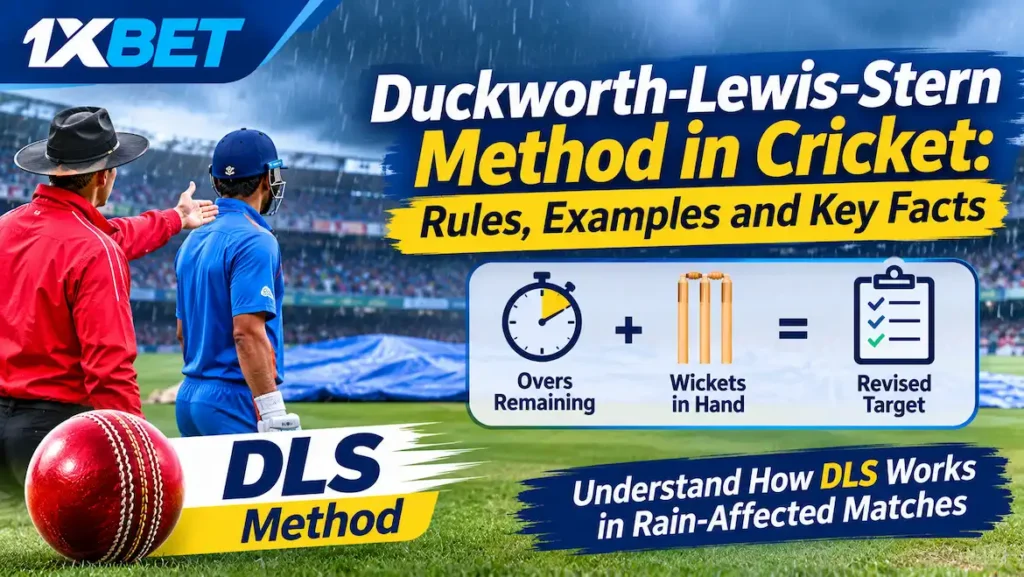
Imagine a team is chasing a target of about 260 runs in a one-day international when rain interrupts play. After the delay, the match resumes with fewer overs available & the target simply changes. Why does this happen & how do officials determine the new score? The answer lies in the Duckworth-Lewis-Stern (DLS) method in cricket, a mathematical system which is used in order to adjust targets in interrupted limited-overs matches.
Moreover, for readers following cricket on 1xBet India, understanding this method makes it easier in order to interpret revised targets, required run rates & rain-affected results. In addition, it even provides useful context for following live scores & match analysis. In this blog, we will explain how the DLS method works, the rules behind it, practical examples & much more.

Duckworth-Lewis-Stern Method in Cricket
DLS is a formula used to calculate a revised target when rain or another interruption cuts the overs available in a limited-overs game. Moreover, its purpose is to account for the scoring opportunities available to both teams rather than relying only on the original target or run rate.
The method was developed by statisticians Frank Duckworth & Tony Lewis and later revised by Steven Stern. It is commonly referred to as the DLS method.
Unlike a simple run-rate calculation, DLS considers two key factors: overs remaining and wickets in hand. Together, these factors help estimate a team’s remaining scoring resources.
For example, a team with 10 overs remaining & eight wickets in hand has different scoring opportunities from a team with the same number of overs but only two wickets remaining. However, the DLS method accounts for these differences when calculating a revised target.
Also Read: Seam Bowling in Cricket: Rules, Examples and Key Facts
How the Duckworth-Lewis-Stern Method in Cricket Works
The DLS method calculates the relative batting resources available to each team. When an interruption changes those resources, the target may need to be adjusted according to the applicable playing conditions.
1. Overs Remaining
The number of overs available determines how many more deliveries a batting team can face. If an ODI is shortened from 50 overs to 35 before the first innings begins, both teams have fewer opportunities in order to score than originally planned.
However, if rain interrupts the second innings, the chasing team may simply lose overs that were previously available. Hence, this reduction affects the resources remaining & can lead to a revised target.
2. Wickets in Hand
Wickets are another important factor because they influence a team’s ability in order to score during the remaining overs.
Moreover, a team with several wickets in hand can generally take more scoring risks than a team close to being bowled out. So even if the overs left stay the same, losing wickets lowers a team’s resources.
3. Resource Percentages & Revised Targets
The DLS method uses resource percentages in order to represent the scoring potential associated with different combinations of overs remaining and wickets lost.
When an interruption occurs, officials determine the relevant resources available to each team & apply the prescribed calculation to establish the revised target.
The result depends on the circumstances of the interruption. A reduction in the chasing team’s resources will generally lower its target, while a reduction in the first team’s resources can lead to an adjusted target for the chasing side.
This is why the DLS method is more sophisticated than simply subtracting runs for every over lost. It considers the resources available to both teams at the relevant stages of the match.
Also Read: Reverse Swing in Cricket: Rules, Examples and Key Facts
DLS Method Example: How a Revised Target Is Calculated
You can consider a hypothetical one-day international match between Team A & Team B.
Team A scores 250 runs in its allotted 50 overs. Team B begins its chase, but rain interrupts play & the officials determine that fewer overs can be completed.
The original target of 251 runs may no longer apply. Moreover, officials must assess the resources available to Team A and Team B & calculate the appropriate revised target using the applicable DLS method.
Suppose Team B has lost several overs but still has wickets in hand. The revised target will depend on how its remaining resources compare with those available to Team A during the first innings.
The exact target cannot be calculated from the original score & the number of overs lost alone. The score at the interruption, wickets lost, overs remaining & the precise interruption circumstances can all affect the calculation.
This example demonstrates an important point: DLS does not simply reduce a target in direct proportion to the overs lost. However, it adjusts the target according to the relative scoring resources available to both sides.
In addition, readers following rain-affected matches through 1xBet India‘s cricket coverage can use this understanding in order to distinguish an original target from a revised one.
DLS Rules: When Is a Match Won, Lost or Declared No Result?
DLS helps officials reach a result, but the final outcome also depends on the rules of the competition, which we will discuss below:
- Win: A chasing team wins when it reaches the revised target within the permitted overs & satisfies the relevant playing conditions.
- Par score: This is the score which is used to assess the chasing team’s position if play stops & the match cannot resume. In addition, the official calculation determines whether the team is ahead of, level with, or behind the required score.
- Tie: This occurs when both teams finish level under the applicable result conditions
- No result: If the minimum overs can’t be completed & no result can be reached, the match can be simply called off as a no-result
Minimum-over requirements & result procedures can vary by format and competition. Readers should therefore avoid assuming that every rain-affected match follows identical conditions.
How DLS Affects Match Analysis & Player Performance
The DLS method can change the tactical situation of a cricket match by altering the target and the number of overs available. As a result, both batting & bowling strategies may need to change after an interruption.
A chasing team facing a revised target might need to increase its scoring rate, while the number of wickets in hand can even influence how aggressively its batters approach the remaining overs. Meanwhile, the bowling side must balance the need to restrict runs with the opportunity in order to take wickets.
For meaningful match analysis, readers should simply consider the revised target alongside the current score, wickets lost, overs remaining & required run rate. Looking at only the original target can give an incomplete picture of the match.
On 1xBet India, understanding these factors can help cricket followers interpret live scores, player performance & sports statistics more accurately. However, DLS does not predict the winner. Moreover, it adjusts the target, while the final result still depends on what happens on the field.
Key Facts About the Duckworth-Lewis-Stern Method
- DLS stands for Duckworth-Lewis-Stern.
- It is used to adjust targets in interrupted limited-overs matches when required by the playing conditions.
- Overs remaining and wickets in hand are central to its resource calculations.
- Moreover, a revised target can simply increase or decrease depending on the resources available to both teams.
- The method uses a fixed mathematical formula, not a simple run-rate tweak
- In addition, a rain interruption does not automatically require a DLS adjustment; the relevant competition rules determine when the method applies.
Conclusion
In the above blog, we have discussed that the Duckworth-Lewis-Stern method in cricket is an essential part of understanding how rain and other interruptions affect limited-overs matches. By considering overs remaining & wickets in hand, it helps officials calculate revised targets that account for the scoring resources available to both teams.
Next time a match is hit by rain, you should remember the difference between an original target, a revised target & a par score. And always read the revised target alongside overs left, wickets in hand & the competition’s playing conditions. That’s the quickest way to understand a rain-affected game on 1xBet India.
To understand a rain-affected match properly, always consider the revised target alongside the remaining overs, wickets in hand & the competition’s playing conditions.