














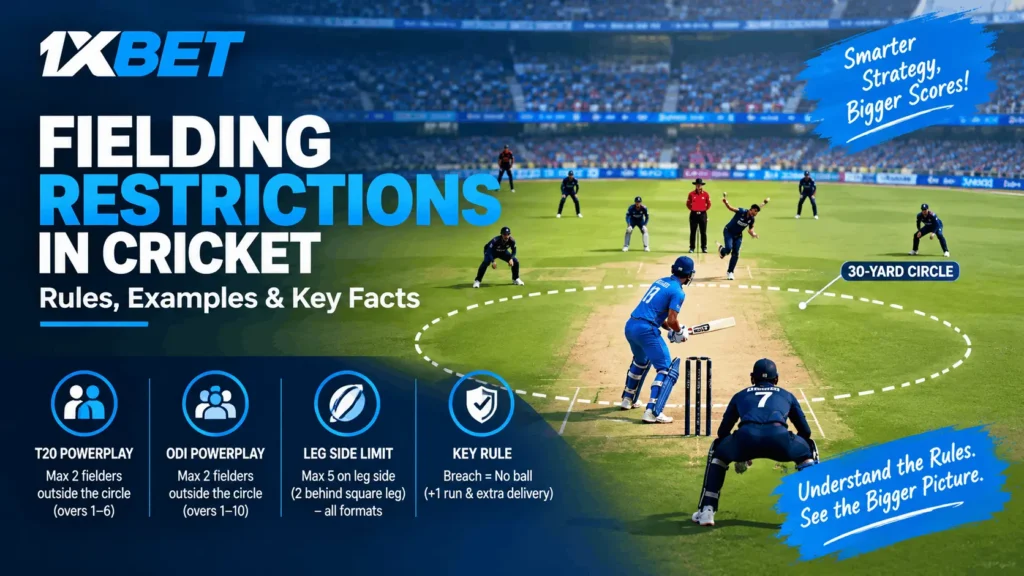
Every limited-overs match contains a phase where the balance of power shifts decisively toward the batting side. During a T20 Powerplay, only two fielders are being permitted outside the circle, which simply leaves large gaps in the infield & the outfield. Moreover, a single well-timed shot can reach the boundary & a few overs can determine the result of the entire contest. These conditions are known as fielding restrictions in cricket & they are among the most influential regulations in the modern game.
For followers of the sport in India, understanding them is essential to reading a match accurately, whether the interest lies in tactics, scorecards, or match analysis. At 1xBet India, our cricket rules series is built to provide clear, accurate & structured explanations of such regulations. This guide covers what the restrictions are, how they apply across formats & much more you need to know.

What is Fielding Restrictions in Cricket ?
Fielding restrictions in cricket are playing conditions that limit how many fielders may stand in specific areas of the ground when the bowler delivers the ball.
- Core principle: a required number of fielders must remain inside the 30-yard circle during restricted overs
- Purpose: to maintain a fair balance between bat and ball and to encourage scoring and boundaries
- Enforcement: on-field umpires verify field placements before each delivery, with support from the third umpire where required
- Scope: the circle-based limits apply mainly to ODIs and T20s, while a separate leg-side limit applies in all formats
The 30-yard circle is the oval marked on the field, measured from the middle stump at each end. Moreover, it serves as the primary reference line for every circle-based restriction in limited-overs cricket. In addition, this is a core piece of cricket terminology that supports a correct reading of commentary & scorecards.
How Fielding Restrictions in Cricket Work Across Formats
The structure of the restrictions differs by format. The table below summarises how fielding restrictions in cricket work in each one.
| Format | Restricted Phase | Fielders Allowed Outside the Circle |
| T20 | Overs 1 to 6 (Powerplay) | Maximum 2 |
| T20 | Overs 7 to 20 | Maximum 5 |
| ODI | Overs 1 to 10 (Powerplay 1) | Maximum 2 |
| ODI | Overs 11 to 40 | Maximum 4 |
| ODI | Overs 41 to 50 | Maximum 5 |
| Test | No circle restriction | Leg side limit only |
Explore More: 1xbetind-Run Out in Cricket: Rules, Examples and Key Facts
T20 Cricket
- The first six overs form the Powerplay, with only two fielders permitted outside the circle
- After the Powerplay, up to five fielders may protect the boundary
- Captains must allocate bowlers carefully, since a single costly over in the Powerplay can concede 15 to 20 runs
ODI Cricket
- The innings is being divided into three phases, each with its own fielding limit
- Moreover, the middle overs (11 to 40) allow four boundary fielders, which generally reduces the scoring rate
- In addition, the final ten overs allow five fielders outside the circle, yet batters frequently accelerate during this period
Test Cricket
- Test matches do not use the 30-yard circle restriction, so captains have wide freedom in field placement
- The leg side limit remains in force and is explained in the next section
Key Fielding Restriction Rules to Understand
The following rules appear in almost every match and form the foundation of the regulations.
- Leg side limit: no more than five fielders may stand on the leg side, and no more than two may stand behind square leg. This applies in all formats.
- Minimum inside the circle: in restricted overs, the required number of fielders must remain inside the 30-yard circle at the moment of delivery
- Breach of the restriction: if the fielding side fails to comply, the umpire may call a no ball, which awards the batting side an additional run & an additional delivery
- Wicketkeeper position: the wicketkeeper must remain behind the stumps until the ball has been delivered
- Free hit: a free hit generally follows an overstepping no ball & the exact application generally depends on the playing conditions of the tournament
Moreover, these provisions are being set out in the ICC playing conditions & the MCC Laws of Cricket. Individual tournaments may adopt minor variations, so the current version for the relevant series should always be consulted. In addition, this is essential knowledge within cricket rules for anyone following the sport closely.
Real Match Examples of Fielding Restrictions in Action
A representative example illustrates how these regulations influence a match, which we have discussed below:
Scenario: a T20 chase of 180 runs
- Overs 1 to 6 (Powerplay): the batting side scores 58 for 1, as the limited number of boundary fielders creates open areas in the field
- Overs 7 to 15: with five fielders on the boundary, the scoring rate falls to approximately about 7.5 runs per over
- Overs 16 to 20: the required rate rises to eight runs per over, and the result generally depends on sound batting & strong player performance in the closing overs
Similar patterns appear regularly in the IPL, T20 World Cups & bilateral series. Moreover, teams that score heavily in the Powerplay frequently carry that momentum through the innings. In addition, comparing the Powerplay scoring rate with the middle overs provides a reliable indicator of which side holds the advantage.
Read More: 1xbetind-No Ball in Cricket: Rules, Examples and Key Facts
Why Fielding Restrictions Matter for Match Analysis
A clear understanding of fielding restrictions in cricket improves the quality of any match assessment.
- Batting strategy: openers adopt an attacking approach early, because the field is widely spread
- Bowling plans: captains select swing and pace bowlers for the Powerplay and spinners for the middle overs
- Captaincy decisions: the timing of bowling changes depends heavily on the number of fielders allowed outside the circle
- Match prediction: Powerplay scores and wickets taken offer strong indicators of the likely outcome
In addition, 1xBet India publishes a dedicated series on cricket rules, including guides on LBW, DRS, run out, stumping & follow-on. Each article is written in order to support a structured understanding of the sport, from basic terminology to advanced match analysis.
Common Misconceptions About Fielding Restrictions
- Misconception: the restrictions apply for the entire innings. Fact: they change by phase in limited-overs cricket.
- Misconception: Test cricket has no fielding regulations. Fact: the leg side limit applies in every format.
- Misconception: the Powerplay & the fielding circle are identical. Fact: the circle is the boundary line, while the Powerplay is the phase that simply determines how many fielders may stand outside it.
- Misconception: every breach results in a free hit. Fact: free hits generally follow overstepping, so the tournament conditions should always be checked.
Conclusion
In the above blog, we have discussed that fielding restrictions in cricket simply shape how limited-overs matches are played, analysed & decided. They influence how freely batters can score, how captains plan their bowling & how momentum shifts across an innings. From the two-fielder limit in a T20 Powerplay to the leg-side rule that applies in every format, these provisions reward both skill & strategy.
Since the rules are being revised from time to time, so you should always refer to the latest ICC playing conditions. To keep learning, you can explore the full cricket rules series on 1xBet India. In addition, please follow all applicable laws & engage responsibly.