














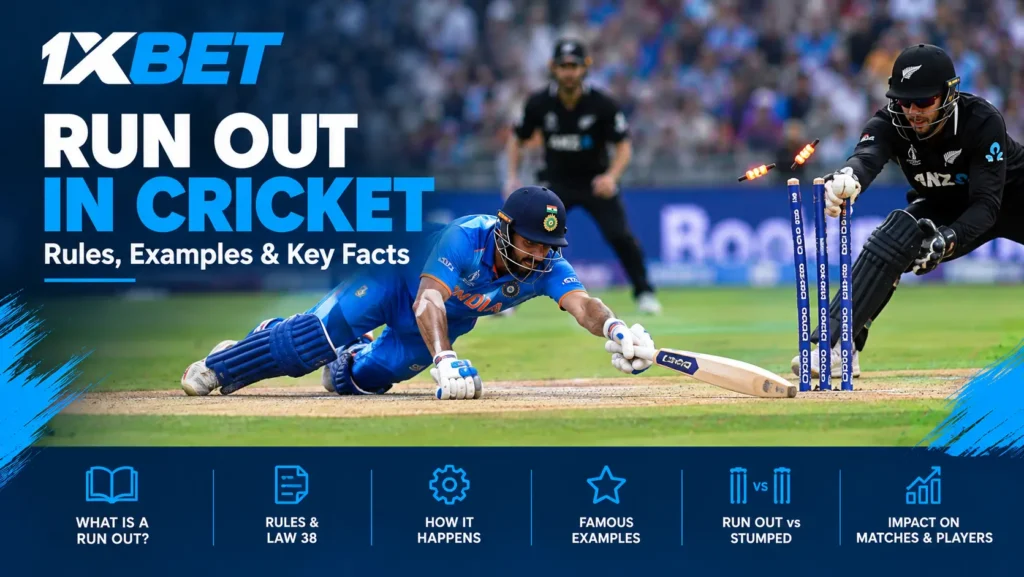
In the 2019 World Cup semi-final at Old Trafford, MS Dhoni was run out by a direct hit from Martin Guptill & India’s pursuit of 240 ended with that single dismissal. For millions of Indian supporters, it remains one of the most memorable moments in the sport, & it demonstrates how decisively a run out in cricket can even alter the outcome of a match. Unlike most dismissals, a run out depends on timing, judgement and precision under pressure & it is not credited to the bowler.
At 1xBet India, we follow cricket closely & understand that supporters want clear, reliable explanations of the rules that shape every match. Run outs are being decided by fractions of a second & are reviewed by the third umpire, so a clear understanding of the law helps you interpret scorecards, replays & live updates accurately. Therefore, this guide explains the rules under Law 38, the process behind each decision, notable examples & the effect run outs have on match results and player performance.

What Is a Run Out in Cricket? (Run Out in Cricket Explained)
A run out occurs when the fielding side breaks the wicket with the ball while a batter is outside the crease & attempting a run. Moreover, it is governed by Law 38 of the MCC Laws of Cricket, the official rulebook followed in international & professional cricket.
The main features of this dismissal are as follows:
- The batter must be out of the crease, meaning neither the bat nor any part of the body is grounded behind the popping crease.
- The wicket must be broken by the ball or by the hand holding the ball.
- Likewise, the dismissal is not credited to the bowler. It is recorded against the fielder or fielders involved.
- On the scorecard, it simply appears as “run out” followed by the fielder’s name in brackets.
This is how a run out in cricket scorecards is always presented & it explains why a skilled fielder can be as valuable to a team as a strike bowler.
How Run Out in Cricket Works: Step by Step
Understanding how run-outs in cricket work is easier when the process is divided into stages. The usual sequence is as follows:
- The run begins. The batters attempt a run after a shot, or the non-striker leaves the crease as the ball is delivered.
- The fielder collects the ball. The throw is directed to the wicketkeeper or the bowler at either end.
- The wicket is broken. At least one bail must be completely removed, or a stump must be uprooted, by the ball or the hand holding it.
- The umpire checks the crease. The key question is whether the batter’s bat or body was grounded behind the line at that moment.
- The third umpire reviews close decisions. Frame-by-frame replays determine whether the batter reached the crease in time.
Which batter is out? In general, it is the batter running towards the end where the wicket was broken who has not made their ground. Umpires therefore assess the position of each batter at the exact moment the stumps are broken.
Read More: 1xbetind-1xbet Cash Out – How Cash Out Works in Sports Betting
Run Out in Cricket Rules You Should Know
Law 38 contains several provisions that are important for understanding close decisions. The key rules are listed below:
- Bat grounded rule: A batter who has grounded the bat behind the line and then lifts it as the stumps are broken is not out. Once the bat or body has been grounded, the batter is considered safe.
- Valid on no balls and wides: A batter can be run out on a no ball or a wide.
- Free hit: A run out is permitted on a free hit, even though most other modes of dismissal are not.
- Non-striker run out: Since October 2022, the run out of a non-striker who leaves the crease early is officially covered under Law 38. In addition, it was previously known as a Mankad & was placed under unfair play.
- Only completed runs count: Runs completed before the dismissal are added to the score. The run in progress at the time of the dismissal is not counted.
- Dead ball: A batter cannot be run out once the ball is dead.
- Hand without the ball: If a fielder breaks the stumps with an empty hand, the batter is not out.
In addition, these provisions carry particular importance in tight finishes, where a single decision can simply determine the result of the match.
Run Out vs Stumped vs Other Dismissals
Run outs are often compared with stumpings because both involve the wicket being broken. The table below outlines the differences.
| Dismissal | Who completes it | Credited to bowler |
| Run out | Any fielder or the wicketkeeper | No |
| Stumped | Wicketkeeper only | Yes |
| Caught | Any fielder | Yes |
| LBW | Umpire’s decision | Yes |
A stumping occurs only when the batter is out of the crease while playing at a delivery, whereas a run out occurs during an attempted run. This distinction is a core part of cricket terminology & is essential for reading scorecards correctly.
Famous Run Out in Cricket Examples
Real matches show how significant a single run out can be.
- MS Dhoni, 2019 World Cup semi-final: India were chasing 240 against New Zealand. Dhoni, who had scored 50, dived to make his ground but was short of the line after Guptill’s direct hit. India lost the match by 18 runs.
- Jonty Rhodes and Inzamam ul Haq, 1992 World Cup: South Africa’s Rhodes dived full length from point and broke the stumps with the ball in hand to dismiss Inzamam. The image is regarded as one of the most famous in cricket history and influenced how teams approach fielding.
In addition, fielders such as Ravindra Jadeja are well known for direct hits that can end an innings in an instant. In T20 cricket especially, run-outs frequently occur when a batting side needs to accelerate, which increases their influence on the result.
How Run Outs Affect Match Analysis & Player Performance
A run out provides valuable information beyond the dismissal itself.
- Partnerships and momentum: A run out can end a strong partnership without the bowler receiving credit & it can shift pressure to the batting side immediately.
- Calling and running between wickets: Repeated run-outs often indicate poor communication between batters. In player performance reviews, this is being treated as a batting discipline issue.
- Fielding value: Direct hits, run-out contributions & catches are tracked as part of sports statistics. They show which fielders save & create runs for their teams.
- Strategy: Captains position their best throwers in key areas & even use fast outfielders late in an innings in order to increase run-out opportunities.
This type of match analysis offers a deeper view than the final score alone, and it forms the basis of the cricket rules content we publish on 1xBet India.
Why Understanding Run Outs Helps You Follow Live Cricket on 1xBet India
Run outs can occur within a fraction of a second & replays often decide the final outcome. Moreover, a clear understanding of the rules offers practical benefits:
- You understand why the third umpire is reviewing a decision & which factors are being assessed.
- You can read live scorecards and updates correctly, including who receives credit for the dismissal.
- You can interpret decisions involving a no ball or free hit accurately.
- You recognise that the final decision rests with the on-field umpires and the official scorer.
At 1xBet India, our objective is to provide supporters with accurate, well-researched information about the game behind every moment. Please note that users must be 18 years or older, and responsible play is always advised.
Conclusion
In the above blog, we have discussed that run-outs in cricket may appear straightforward, but it depends on precise regulations covering the crease, the broken wicket & the third umpire’s review. As this guide has shown, the dismissal is valid on no balls, wides and free hits; it is never credited to the bowler & it can simply influence partnerships, momentum & final results.
Moreover, a thorough knowledge of Law 38 allows you to interpret live decisions with greater accuracy and to appreciate the skill, discipline & coordination required of both batters and fielders. In addition, to continue building your understanding of the game, you can simply explore more cricket rule guides, detailed match insights & live coverage on 1xBet India.