














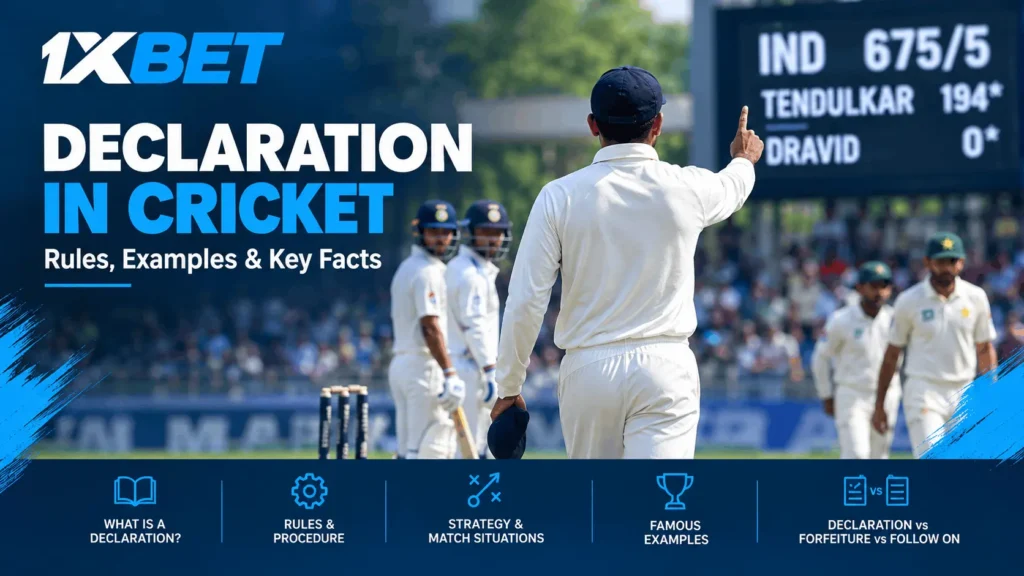
In March 2004, India posted 675 for 5 against Pakistan in Multan & Sachin Tendulkar was unbeaten on 194 when captain Rahul Dravid closed the innings. Moreover, the decision divided opinion among players, analysts & supporters for years, and it remains one of the most discussed moments in Test history. At 1xBet India, we believe such moments show why cricket rewards those who understand its finer points. A single call by the captain can simply shift the balance of an entire match, and many followers of the game still find the concept difficult to interpret in real time.
So what exactly is a declaration in cricket? It is the decision of the batting captain to end his own team’s innings before all ten wickets fall, so that more time is available to dismiss the opposition. This guide covers the rule, the process, the strategy & notable examples, so that you can follow every Test match with clarity and informed judgement.

Declaration in Cricket Explained: What the Rule Says
A declaration means the batting side voluntarily closes its innings before it is bowled out or before any over limit is being reached. The Laws of Cricket, maintained by the MCC, set out the following key points:
- Only the batting captain may declare
- It can be made at any time when the ball is dead
- It is permitted in any innings of a match that has no over limit
- Once made, it cannot be withdrawn
- All runs and wickets remain on the scoreboard
In essence, the captain gives up the remaining batting time in exchange for additional time to take wickets. It is an essential piece of cricket terminology for anyone who follows the longer format of the game.
Explore More: 1xbetind-Betting App Cricket – Cricket Markets and Betting Features
How Declaration in Cricket Works Step by Step
The procedure is straightforward, but the timing carries great importance. A typical declaration follows this sequence:
- The captain reviews the score, the pitch &d the time remaining in the match.
- He then informs the batters & umpires, either from the dressing room or through a signal.
- The umpires confirm the closure of the innings once the ball is being dead.
- In this step, the batting side simply takes the field & the opposition prepares in order to bat.
- Lastly, the opposition either chases a target or attempts to survive until stumps.
Consider a team that scores 320 for 4 on day three & declares. The opposition then has two days in order to chase the total or play for a draw. Therefore, the declaring captain must be confident that his bowlers can take ten wickets in the time available.
Why Captains Declare: Match Situations and Strategy
Every declaration reflects careful judgement. Effective match analysis begins with the following factors:
- Time versus runs: Whether the lead is large enough and whether sufficient time remains to bowl the opposition out.
- Pitch condition: A worn surface on day four or five assists spinners & simply makes a target harder to chase.
- Weather: A forecast of rain can compel a captain to declare earlier in order to protect the chance of a result.
- Series situation: A team that needs a win may accept greater risk, while a team leading the series may prefer caution.
- Bowling strength: The quality of the pace & spin attack determines how much time is actually being required.
Individual player performance even influences the decision. A captain may allow a batter in order to reach a milestone, or may close the innings as soon as the lead is sufficient. Moreover, declaring too early hands the opposition an easy chase. In addition, declaring too late can waste a genuine opportunity to win, which is why every declaration invites debate.
Famous Declarations in Cricket with Examples
Some of the most notable sports statistics in Test history are connected to declarations. The following three cases illustrate how different the outcomes can be:
- Multan, 2004: India declared at 675 for 5, with Tendulkar on 194 not out and Virender Sehwag having scored 309. India won by an innings and 52 runs, and the decision was ultimately vindicated.
- Antigua, 2004: West Indies declared at 751 for 5 with Brian Lara on 400 not out, a record individual score in Test cricket. The match ended in a draw against England.
- Port of Spain, 1968: Garry Sobers declared West Indies’ second innings and set England a demanding target in limited time. England achieved it and won, which made this one of the most debated declarations ever.
Readers are advised in order to verify all scores against trusted sources such as ESPNcricinfo or the ICC. In addition, these examples even show that a declaration may appear bold or reckless, depending on the final result.
Declaration vs Forfeiture vs Follow On
These three terms are generally confusing, so a clear distinction is useful which we have discussed below:
- Declaration: The batting captain closes an innings that is already in progress
- Forfeiture: A captain gives up an entire innings without batting in it
- Follow on: The team with a substantial first innings lead may ask the opposition to bat again immediately
A declaration and a forfeiture are decisions taken by the side that is batting. A follow on is a decision taken by the leading side’s captain after both first innings are complete.
Declaration in Cricket in Cricket Formats: Where Does It Apply?
A declaration is possible only in formats where batting time is not limited by overs. It applies in:
- Test matches
- First class and multi day matches
It does not apply in ODIs and T20s, because every innings in those formats is capped at a fixed number of overs. For this reason, the tactic is seen only in the longest format of the game.
How Understanding Declarations Helps You Follow Matches on 1xBet India
At 1xBet India, our aim is to help cricket followers understand the game in depth. A declaration changes the match situation immediately:
- The target becomes clear
- The overs and sessions remaining become the central factor
- The required run rate alters the balance between the two sides
With this understanding, live scores & match statistics on 1xBet India become easier to interpret. You can see why a captain chose to declare and what outcomes are likely to follow. This guide is provided for information only. Our platform is intended for users aged 18 and above & we simply encourage all users to play responsibly.
Read More: 1xbetind-Ultimate Guide to the 1xbet Cricket Betting App
Conclusion
To conclude, a declaration in cricket is one of the most meaningful tactical tools which is available to a captain. It simply converts runs into time & it reflects the captain’s reading of the pitch, the weather, the opposition and the strength of his own bowling attack. As the examples from Multan, Antigua and Port of Spain show, the same decision can be praised or criticised depending on the result, which is what makes the concept so central to Test cricket. Moreover, a clear understanding of the rule, the procedure & the strategic reasoning allows followers in order to analyse each innings with greater accuracy and appreciate the thinking behind it. We invite you to explore more cricket rules guides, live coverage and match insights on 1xBet India and to use this knowledge to follow every Test match with confidence & a deeper appreciation of the game.