














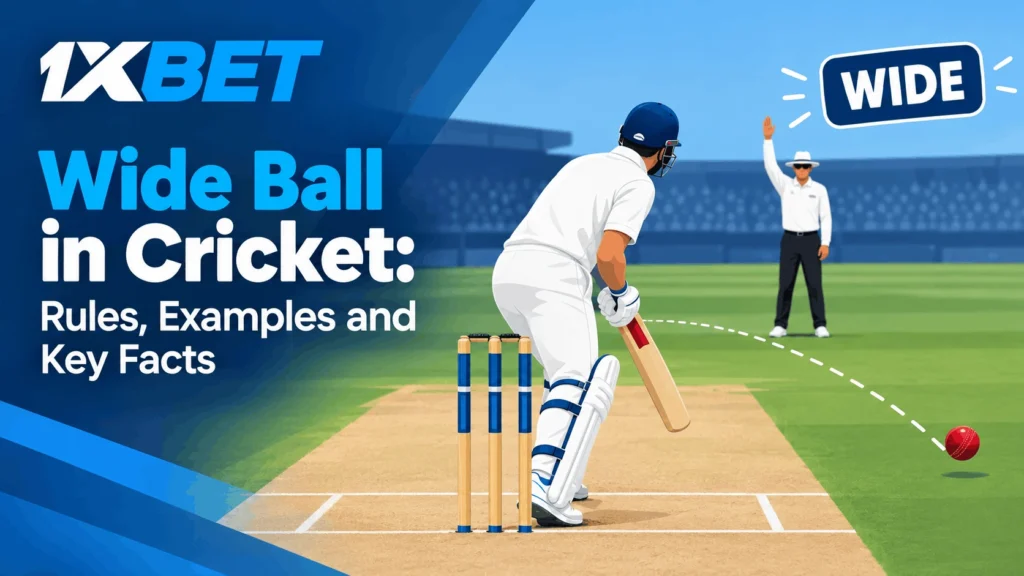
A delivery that misses the batter by a considerable distance can simply change the situation in a cricket match, even when the batter does not play a shot. The umpire may call it a wide, awarding an extra run to the batting team & requiring the bowler in order to deliver another legal ball. Moreover, understanding the wide ball in cricket helps fans to follow scorecards, analyse bowling performance & understand important umpiring decisions. In this guide, 1xBet India explains the rules, scoring system, practical examples & much more every cricket follower should know.
What Is a Wide Ball in Cricket?
A wide ball is a delivery that the umpire considers too far from the batter to be played with a normal cricket stroke, according to the applicable playing conditions. It can pass too far outside the batter’s reach or, under relevant conditions, above the batter’s head.

Moreover, the purpose of this rule is to simply prevent bowlers from delivering balls that are unfairly difficult for the batter to reach. However, a delivery is not automatically wide simply because it passes outside the off stump or leg stump. The umpire even considers the batter’s position, movement & ability in order to play the ball.
Wide Ball in Cricket Explained: What Are the Official Rules?
The rules governing a wide ball are set out in the Laws of Cricket & the playing conditions which are used by individual competitions. Under the standard principles, the umpire judges whether the delivery passes beyond the batter’s reasonable reach. Now, we will discuss the main points to understand:
- Distance from the batter: A delivery that passes too far away for the batter to hit with a normal cricket stroke may be called wide.
- Batter’s movement: The umpire considers the batter’s position & movement when assessing the delivery. Moreover, a batter moving across the crease can simply influence the decision.
- Height of the delivery: Under applicable playing conditions, a ball passing above the head of a batter standing upright at the popping crease may be called wide. The precise wording & application should be checked against the competition’s rules.
- Umpire’s judgement: The decision generally depends on the circumstances of the delivery, rather than one universal distance that applies to every situation.
In limited-overs cricket, which includes ODIs & T20 matches, playing conditions may include specific interpretations which are designed to account for batters moving around the crease. Therefore, fans should avoid assuming that every delivery outside a marked line must be called wide.
Explore More: 1xbetind-Ultimate Guide to the 1xbet Cricket Betting App
How a Wide Ball in Cricket Works During a Match
When an umpire judges a delivery to be wide, the umpire calls & signals the decision. The batting team receives one extra run as the standard wide penalty.
A wide also has an important effect on the over. Moreover, in a standard six-ball over, only legal deliveries count towards the six-ball requirement. If a bowler delivers a wide, another delivery must be bowled in order to complete the over.
You can consider this example that if a bowler delivers five legal balls & then bowls a wide. In this case, the team receives an extra run, but the over is not complete. Therefore, the bowler must deliver another legal ball before the over can finish.
Likewise, you should understand that the ball does not automatically become dead when a wide is called. Batters may still run, and the ball may reach the boundary. Any additional runs or boundary allowance are recorded according to the applicable scoring rules.
For cricket followers using 1xBet India to follow match information, understanding this rule makes it easier to interpret changes in the score, the number of balls bowled & a bowler’s performance during a close contest.
Wide Ball Rules With Practical Cricket Examples
The easiest way to understand wide-ball decisions is to look at common match situations which we have discussed below:
Example 1: A delivery outside off stump
A right-handed batter takes a normal stance, but the bowler simply sends the ball far beyond the batter’s reach outside off stump. Moreover, if the umpire judges that a normal cricket stroke is not possible, the delivery is called as wide.
Example 2: A batter moves across the crease
A batter moves towards the off side before the ball arrives. The umpire considers the batter’s movement & position under the applicable playing conditions. The delivery is not automatically wide just because it passes outside the original line of the batter’s stance.
Example 3: A wide reaches the boundary
The bowler delivers a wide & the ball travels past the wicketkeeper to the boundary. The batting team receives the wide penalty and the applicable boundary allowance. Likewise, the final number of extras generally depends on the circumstances & the scoring rules.
Example 4: A delivery passes close to the batter
A ball travels outside off stump but remains within reach for a normal shot. The umpire may decide that it is a legitimate delivery rather than a wide.
These examples simply show why the umpire’s assessment matters. However, the line of the ball alone does not always determine the decision.
How Many Runs Does a Wide Ball Add in Cricket?
A wide ball carries a standard penalty of one extra run for the batting team. The total runs resulting from the delivery can be higher if the batters complete runs or a boundary allowance applies.
For instance, if the umpire calls a wide & the batters complete two runs while the ball remains in play, the score generally includes the one-run wide penalty plus the completed runs, which is subject to the applicable rules. Moreover, the total is recorded as wides rather than credited to the batter as runs from a shot.
Wide runs are included in the team’s total & are generally charged against the bowler. They can even affect the bowler’s economy rate & overall bowling figures.
In addition, a wide is different from a no-ball, which is called for specific infringements, such as certain front-foot or bowling-related offences. Both carry a standard one-run penalty in ordinary circumstances, but their rules & consequences differ.
How Wide Balls Affect Match Analysis & Player Performance
Wides may appear to be minor events in a scorecard, but several of them can even influence the course of an innings. In a short-format match, even a few unnecessary extras can simply increase the target, or they can reduce the margin for error when defending a total.
Moreover, repeated wides can also indicate a lack of control over line & length. A bowler who’s trying to keep the ball away from a powerful batter may miss the intended area & give away free runs. However, one wide alone does not establish that a bowler has performed poorly; the wider match context matters.
From a match-analysis perspective, useful statistics include the number of wides conceded, total extras, runs which is conceded by each bowler & the number of legal deliveries completed. In addition, these figures help explain why an over went longer than expected or why a team’s score increased without a batter scoring from a shot.
Wide Ball vs No-Ball in Cricket: Key Differences
| Basis | Wide Ball | No-Ball |
| Meaning | A delivery that is beyond the batter’s reasonable reach under the applicable playing conditions. | A delivery that violates specific rules, such as overstepping the popping crease. |
| Main reason | The ball is too far from the batter to play a normal cricket stroke or meets the relevant height criteria. | The bowler commits an infringement covered by the no-ball rules. |
| Penalty runs | Normally 1 extra run. | Normally 1 extra run. |
| Counts as a legal ball? | No, it does not count towards the six legal balls in an over. | No, it does not count towards the six legal balls in an over. |
| Free hit | Not awarded for a wide alone. | Awarded after many types of no-balls in limited-overs formats, subject to the applicable playing conditions. |
| Effect on scorecard | Recorded as wides under extras. | Recorded as no-ball extras. |
Read More: 1xbetind-1xBet Registration Guide: Create Your Account in Just a Few Minutes
Final Thoughts
To conclude, a wide ball in cricket is more than an extra run on the scoreboard. It affects the length of an over, the bowler’s statistics, and the batting team’s total. However, the decision depends on the delivery, the batter’s position and movement & the playing conditions governing the match.
By understanding these rules & recognising common examples, cricket fans can simply follow umpiring decisions and match statistics with greater confidence. In addition, 1xBet India provides cricket-related information for readers who want to understand the rules & key developments that shape the game.