

























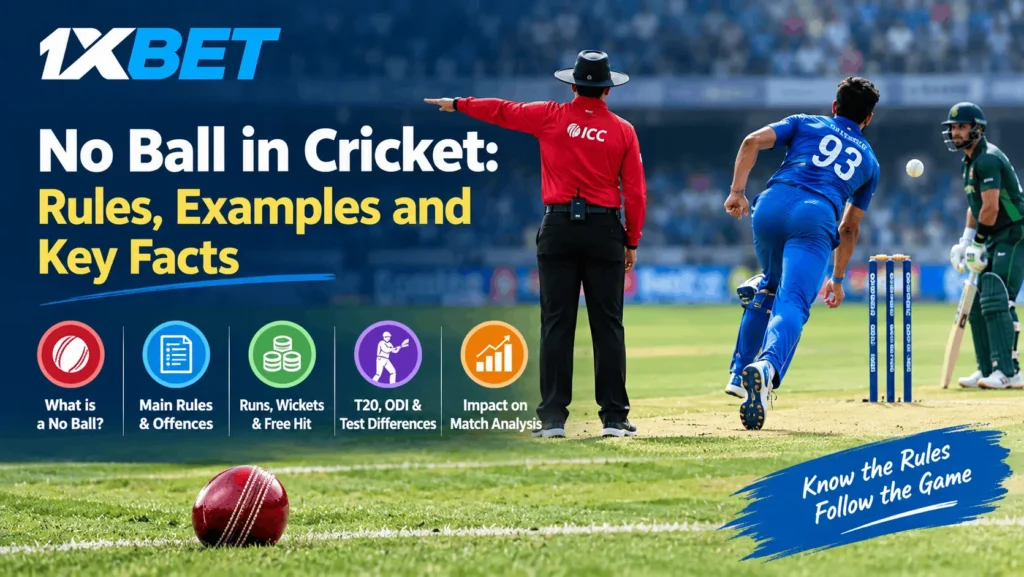
A batter edges the ball towards the boundary, or a bowler finally gets the wicket they have been chasing. But before the moment can be celebrated, the umpire raises one arm horizontally & signals a no-ball. Suddenly, the delivery is ruled illegal, the batting team receives an extra run & the batter may get another chance.
Moreover, understanding a no-ball in cricket helps fans in order to follow match scores, wickets & important turning points more accurately. For readers following cricket through 1xBet India, knowing these rules also makes live match analysis easier to understand.

In this blog, we will look at what causes a no-ball, how the penalty works & which rules matter most across different cricket formats.
What Is a No Ball in Cricket?
A no-ball is an illegal delivery that is called by the umpire when the bowler or fielding side breaches a specific cricket rule. The most familiar example is a bowler who’s stepping over the popping crease while delivering the ball.
Under the standard Laws of Cricket, a no-ball gives the batting team one penalty run. Any additional runs scored from the delivery are added according to the applicable scoring rules. In addition, the delivery does not even count as one of the six valid balls in an over.
A no-ball can have a significant effect on a match because it may prevent a dismissal, extend an over & create another scoring opportunity. In limited-overs cricket, it even generally leads in order to a free hit on the next delivery under the applicable playing conditions.
Also, the umpire signals a no-ball by extending one arm horizontally. This simply helps players, spectators & scorers recognise the decision.
No Ball in Cricket Explained: What Are the Main Rules?
A no-ball can be called for several reasons. Front-foot faults are common, but the rules also cover the way a ball is delivered, its path towards the batter & certain fielding restrictions.
1. Front-Foot No-Ball
This is one of the easiest no-ball offences to recognise. The bowler must land the front foot correctly during the delivery stride, with part of the foot behind the popping crease. If the front foot lands beyond the permitted line, the umpire calls a no-ball.
Moreover, even a small overstep can be costly, particularly when a batter is attacking during the final overs of a T20 match.
2. Illegal Bowling Actions & Deliveries
Cricket rules prohibit certain unfair or illegal bowling actions. For example, a delivery judged to have been thrown rather than bowled in accordance with the applicable rules can result in a no-ball call.
Moreover, the bowler must also follow the declared mode of delivery. Failing to inform the umpire about a change from right-arm to left-arm bowling, or from over the wicket to round the wicket, can simply result in a no-ball.
3. High Full Tosses
A full toss reaches the batter without pitching first. If it passes above the permitted waist-height limit under the relevant playing conditions, it can be called a no-ball.
Dangerous or unfair non-pitching deliveries are also covered by specific rules. Moreover, the exact decision depends on the delivery & the applicable conditions.
4. A Ball That Bounces More Than Once
A delivery that bounces more than once or rolls along the ground before reaching the popping crease can be called a no-ball, provided the batter has not already touched it with the bat or person. In addition, a ball that pitches wholly or partly off the pitch before reaching the striker’s wicket can also fall under this rule.
5. Fielding Restrictions & Other Offences
A no-ball may also result from certain fielding violations, such as having too many fielders outside the permitted area or breaching other restrictions under the playing conditions.
Moreover, the umpire makes the decision according to the relevant rule. You need to understand that not every unusual delivery is automatically a no-ball, so the circumstances matter.
Explore More: 1xbetind-Ultimate Guide to the 1xbet Cricket Betting App
How No Ball in Cricket Works: Runs, Wickets & Free Hits
Knowing the definition is only part of understanding the rule. Moreover, the bigger question for many viewers is what happens to the score & the batter when a no-ball is called.
1. How Many Runs Are Awarded for a No-Ball?
The batting team normally receives one penalty run for a no-ball. This run is recorded as a no-ball extra & charged to the bowler.
Suppose a bowler oversteps & the batter hits the ball for four. The batting team receives five runs in total: one no-ball extra & four boundary runs. If the batter scores runs in another way, the score is recorded according to the relevant rules for the delivery.
2. Can a Batter Get Out on a No-Ball?
A no-ball protects the batter from most conventional forms of dismissal, which include bowled, caught, leg before wicket (LBW), stumped & hit wicket.
However, the batter is not completely safe. Under the standard Laws, a batter can still be dismissed through a run-out, obstructing the field, or hitting the ball twice. The applicable playing conditions should be checked for the match being followed.
This is why a no-ball decision can simply change the result of an apparent wicket. Moreover, if the bowler knocks over the stumps but the umpire has called a no-ball, the batter generally remains at the crease.
3. Does a No-Ball Count as a Ball in the Over?
No. A no-ball does not count towards the six valid deliveries required to complete a standard over. The bowler must deliver another valid ball before the over can be completed.
In addition, repeated no-balls can therefore increase the number of deliveries & runs in an over, putting additional pressure on the bowling side.
4. What Is the Free-Hit Rule?
In standard international ODI and T20I cricket, a no-ball is being followed by a free hit under the applicable playing conditions. On this delivery, the batter has protection from most conventional dismissals, although run-out & certain other dismissals remain possible.
If the free-hit delivery is itself a no-ball or a wide, the next delivery remains a free hit under the standard ICC limited-overs rule.
The free-hit provision is not a universal feature of every cricket format. Readers should check the competition’s playing conditions rather than assume that every no-ball in every form of cricket produces one.
No-Ball Rules in T20, ODI & Test Cricket
The basic principles of a no-ball are similar across cricket formats, but some consequences differ, which we have discussed below:
- T20 cricket: A no-ball can be especially important because every run matters in a short innings. The extra run, the additional delivery & the free hit can simply give the batting side another opportunity in order to increase its total.
- ODI cricket: The standard no-ball penalty & free-hit provision apply under international ODI playing conditions. Moreover, a no-ball can even affect the required run rate, particularly during a close chase.
- Test cricket: The one-run penalty & the rule that a no-ball does not count as a valid ball still apply under standard Test playing conditions. However, Test cricket does not even use the standard limited-overs free-hit provision.
Also, you need to note that competition-specific rules can differ, so the relevant playing conditions remain the best reference when an unusual situation arises.
How a No-Ball Can Change Match Analysis
A no-ball is not just a minor scoring detail. It can influence how a match develops, especially when the score is close.
For example, if a batter is nearly dismissed during a tense run chase, a no-ball can simply keep them at the crease & give them another scoring opportunity. You should know that the extra run can even affect the required run rate, while the free hit in limited-overs cricket may change the next delivery’s risk & reward.
Moreover, repeated no-balls can point to problems with a bowler’s control or rhythm. Likewise, a single no-ball does not necessarily mean that the bowler is performing poorly.
In addition, for readers following cricket on 1xBet India, understanding these details can simply help you to put live scores & match statistics into context. Therefore, it is useful in order to consider the score, wickets remaining, overs left & the reason for the no-ball rather than simply judging a match from one incident alone.
No-Ball in Cricket: Practical Examples to Remember
In this section, we have discussed three simple situations that show how the rule works:
- The bowler oversteps & the batter hits a six: The batting team receives the six runs from the boundary plus the one-run no-ball penalty, making seven runs in total.
- The batter is bowled after a front-foot no-ball: The dismissal does not stand because the batter cannot normally be out bowled from a no-ball. The penalty run is still awarded.
- A no-ball is called during a T20 match: The batting team receives the penalty run & the next delivery is a free hit under the standard international T20I playing conditions.
These examples illustrate why umpires’ decisions & the correct interpretation of cricket rules matter when reading a scorecard.
Read More: 1xbetind-1xbet Aviator Game : Play Online in Best Betting Site in India
Conclusion
To conclude, a no-ball in cricket can simply affect the score, the batter’s dismissal, the number of deliveries in an over & the next ball in limited-overs matches. While a front-foot fault is the most familiar example, other offences that involve bowling actions, dangerous deliveries & fielding restrictions can even lead to the call. Moreover, for cricket fans following matches through 1xBet India, understanding these rules makes scorecards & match situations easier to interpret.