











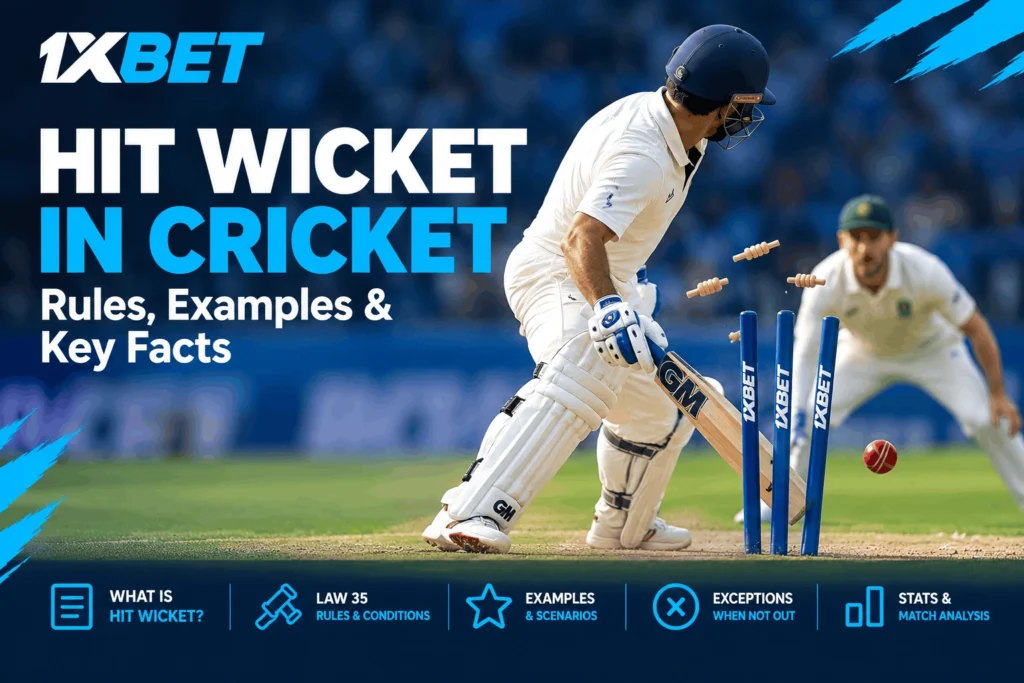
A batter plays a confident shot, the ball travels toward the boundary, and then the bails fall from his own stumps. Moreover, no bowler has beaten him & no fielder has taken a catch, yet the umpire raises the finger. This is hit wicket in cricket, one of the rarest & most misunderstood modes of dismissal in the game. For Indian cricket followers who track every ball of a Test, ODI or IPL match, such a moment often raises immediate questions about whether the decision was fair and what the law actually states.
At 1xBet India, we believe that informed fans enjoy the sport more, which is why this guide sets out the rule, its exceptions, practical examples and its relevance to match analysis. By the end, you will have a clear and reliable understanding of how this dismissal works.

What Is Hit Wicket in Cricket?
Hit wicket is a mode of dismissal in which the batter breaks his own wicket while playing a shot or setting off for a run. The wicket can be broken by:
- The bat or any part of the batter’s body
- His clothing, such as a cap or shirt
- His equipment, such as a helmet, glove or pad
In the scorecard, the dismissal is recorded as “hit wicket b Bowler Name”. The wicket is credited to the bowler, even though the batter’s own action caused it. The rule applies in Tests, ODIs and T20 matches, including the IPL.
Compared with bowled, caught or LBW, this dismissal is uncommon. Its rarity is the main reason it draws attention and confusion when it occurs during a live match followed on 1xBet India.
Hit Wicket in Cricket Explained: What Law 35 Says
The rule is defined in Law 35 of the MCC Laws of Cricket, the code that governs the game worldwide. Moreover, a batter is out hit wicket when his wicket is put down by his bat or person after the bowler has entered his delivery stride & while the ball is in play.
Law 35 covers three situations:
- Receiving the ball: the batter breaks the stumps while preparing for or playing a delivery.
- Setting off for a run: he breaks the wicket while leaving the crease for the first run, immediately after playing or playing at the ball.
- Second stroke: he breaks the wicket while lawfully playing a second shot to guard his stumps.
The key term is put down. At least one bail must be fully removed from the top of the stumps, or a stump must be pulled out of the ground. A bail that only wobbles does not constitute a dismissal.
A quick summary of the rule:
- Timing begins when the bowler enters his delivery stride
- The batter’s own action must break the wicket
- The wicket must be fully broken, not merely disturbed
How Hit Wicket in Cricket Works on the Field
Understanding how hit wicket in cricket works is easier when the process is broken into steps which we have discussed below:
- Firstly. the bowler enters his delivery stride and the ball is in play.
- The batter moves, either to play the ball or to set off for a run.
- Now, his bat, body, clothing or equipment dislodges the bails or stumps.
- Lastly. the umpire assesses the situation and gives the decision. In unclear cases, the third umpire reviews the replay.
A typical scenario involves a batter moving deep into his crease against a fast bowler. He loses balance while playing a back foot shot, and his heel or bat strikes the stumps. Another example is a batter whose helmet falls off after a play and miss and lands on the stumps. Both situations result in hit wicket, because the helmet is classed as the batter’s equipment.
Explore More: 1xbetind-Ultimate Guide to the 1xbet Cricket Betting App
When Is a Batter Not Out Hit Wicket?
Knowing the exceptions is as important as knowing the rule. In addition, a batter is not out in the following cases:
- No ball: if the delivery is a no ball, he cannot be given out hit wicket. However, the same principle applies on a free hit.
- Before the delivery stride: if the wicket breaks before the bowler enters his stride, it is not a dismissal.
- Dead ball: if the ball is dead when the wicket breaks, the batter remains at the crease.
- Broken by someone else: if a fielder, the wicketkeeper or the umpire breaks the wicket, it is not hit wicket.
When following a match live, you should always check the replay & the no ball signal before concluding that a dismissal has occurred. Likewise, this detail is frequently overlooked & can even change how a passage of play is understood.
Hit Wicket Examples, Player Performance and Statistics
Hit wicket dismissals occur at every level of cricket, from club fixtures to international matches. Two common situations illustrate how the rule is applied:
- A well established opener plays a cut shot, loses his balance, and his bat strikes the off stump. He is out, and the bowler receives the credit.
- A batter sets off for a quick single after a push to mid on. His back foot dislodges the bails as he turns. He is out hit wicket.
These incidents matter for player performance analysis. A batter who has built a steady half century can lose his innings through a single movement. The bowler’s figures improve without any bowling skill being involved, which is why analysts study how each dismissal happened and not only the wicket column.
In terms of sports statistics, hit wicket is among the least frequent dismissals. Bowled, caught & LBW account for the large majority of wickets in international cricket. However, for accurate figures & notable historical cases, readers can consult records published by the ICC and ESPNcricinfo. Our other cricket rules guides on 1xBet India, covering LBW, Run Out and Stumping, offer a complete picture of how batters are dismissed.
Why Hit Wicket Matters for Match Analysis and Live Cricket
Serious match analysis goes beyond the scoreline. Understanding each dismissal type explains why a match shifts in a particular direction. A hit wicket can end a strong partnership instantly, increase pressure on the batting side and change momentum without warning.
This is where 1xBet India provides value for cricket followers. Our rule guides and cricket terminology explainers are designed to help readers interpret each decision as it happens, so that a live scorecard is clear and complete. A sound knowledge of the laws allows fans to follow the game with greater confidence and fewer doubts about the umpire’s call.
Our platform is intended for adults aged 18 and above, and all related activity should be undertaken responsibly and within personal limits.
Conclusion
In the above blog, we have discussed that hit wicket in cricket may be a rare dismissal, but it is a rule that every informed follower of the game should understand. Moreover, it occurs when a batter’s own bat, body, clothing or equipment breaks his wicket after the bowler has simply entered his delivery stride & it is recorded as a wicket for the bowler. Two points deserve particular attention. The batter’s own action must be the cause of the broken wicket, and a no ball always means he is not out. Together with the exceptions for dead balls and wickets broken by others, these principles make most hit wicket decisions straightforward to interpret.
A clear grasp of such laws improves the way a match is read, from individual player performance to the larger flow of an innings. To continue building that knowledge, explore the full range of cricket rules guides, terminology explainers and match insights on 1xBet India at 1xbetind.com.