
























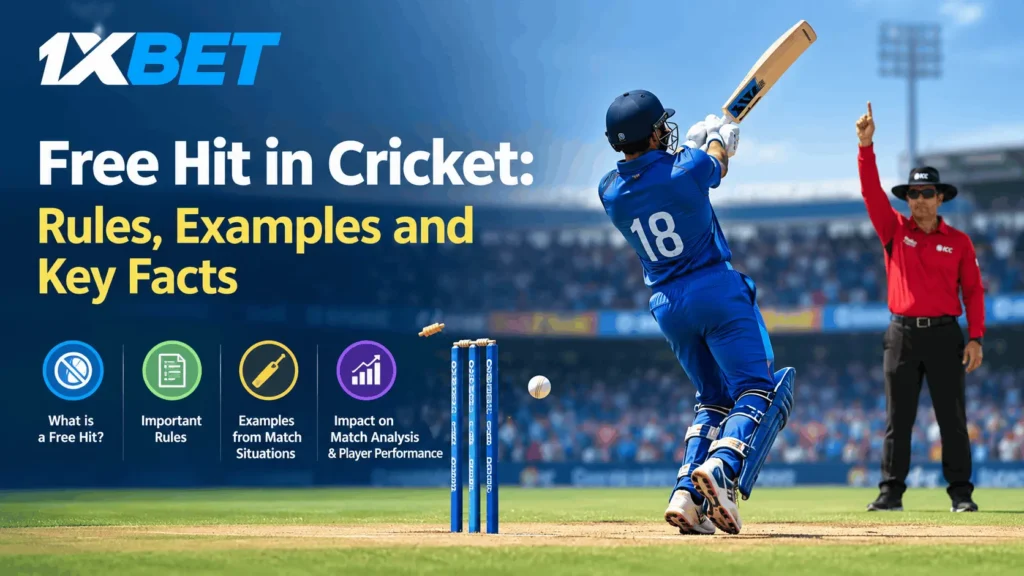
A bowler oversteps the crease; the umpire signals a no-ball & the next delivery suddenly becomes a major opportunity for the batter. This is what makes a free hit in cricket such an interesting moment, especially during close T20 and ODI matches.
A free hit gives the batter protection against several common forms of dismissal, but it does not make them completely safe. A run out, for example, is still possible under the applicable rules.

Moreover, for cricket fans exploring match information on 1xBet India, understanding this rule can make it easier to follow live match developments, interpret scorecards & assess player performance. This guide covers how a free hit works, the important cricket rules, examples & the factors that matter during match analysis.
How Free Hit in Cricket Works
A free hit is awarded on the delivery immediately following a no-ball in standard ICC limited-overs cricket, including One Day Internationals (ODIs) & T20 Internationals (T20Is). The rule gives the batter an additional advantage because most common dismissal methods do not apply.
Moreover, a no-ball may be called for different reasons, including a bowler overstepping the popping crease with the front foot or committing another infringement covered by the playing conditions. Now, we will discuss how the process works:
- The bowler delivers a no-ball & the umpire signals the infringement.
- The batting team receives the applicable no-ball penalty, normally one extra run.
- Now, the next delivery becomes a free hit for the batter facing it.
- Likewise, if the free-hit delivery is also a no-ball or wide, the following delivery remains a free hit.
The umpire signals a free hit by raising one arm & moving it in a circular motion after signalling the no-ball.
When following cricket match information on 1xBet India, knowing this sequence helps readers understand why a batter receives another protected delivery after certain illegal deliveries. In addition, it even explains why the number of legal balls in an over may differ from the total deliveries bowled.
Free Hit in Cricket Explained: Important Rules
A free hit creates a scoring opportunity, but both batters & fielders must still follow the relevant playing conditions which we have discussed below:
1. Which Dismissals Are Allowed on a Free Hit?
Under standard ICC limited-overs playing conditions, the striker can be dismissed only through methods that apply to a no-ball. These include the following:
- Run out: The batter can be dismissed if the fielding side legally breaks the wicket while the batter is outside their ground & the conditions for a run out are met.
- Obstructing the field: A dismissal is possible if the batter’s actions simply meet the rules for this method.
- Hit the ball twice: A batter can be dismissed for deliberately hitting the ball a second time, which is subject to the applicable exceptions.
In addition, dismissals such as bowled, caught, LBW & stumped are not permitted on a free hit under these conditions.
For example, if a batter misses the ball & it hits the stumps, the batter is not out bowled. However, if the batter attempts a quick single & fails to reach the crease before the wicket is broken legally, a run out can still occur.
Explore More: 1xbetind-Betting App Cricket – Cricket Markets and Betting Features
2. Can a Batter Score Runs on a Free Hit?
Yes. A batter can score through boundaries, running between the wickets & other scoring methods permitted by the rules.
If the batter hits the ball over the boundary without it bouncing, the team receives six runs. If the ball reaches the boundary after bouncing, the team normally receives four runs.
Moreover, the original no-ball penalty is recorded separately from runs scored on the free-hit delivery. A free hit does not automatically add a fixed number of runs beyond the applicable extras.
3. Can Fielders Change Positions During a Free Hit?
Fielding changes are generally restricted between the no-ball & the free-hit delivery. However, the standard ICC limited-overs rules allow certain exceptions, including a change of striker and adjustments needed to correct a fielding-restriction breach.
In addition, these restrictions prevent the fielding team from freely rearranging its positions after the no-ball.
4. Does a Free Hit Count as a Ball in the Over?
A legitimate free-hit delivery counts as one ball in the over. Moreover, a no-ball or wide does not count as a legal delivery, so the bowler must deliver another ball. If that delivery is also a no-ball or wide, then in this case the free hit continues.
In addition, these details are useful when following overs, scoring updates & match statistics on 1xBet India.
Free Hit in Cricket: Examples From Match Situations
A few simple examples show how the rule works during an actual innings, which we have discussed below:
Example 1: The batter hits a six
A bowler oversteps the crease, and the umpire calls a no-ball. The batter hits the next delivery over the boundary for six.
The batting team receives the no-ball extra and the six runs from the boundary. The two scoring elements are recorded separately.
Example 2: The ball hits the stumps
The batter attempts an attacking shot but misses the free-hit delivery. In this case, the ball passes through & hits the stumps.
Although this would normally result in a bowled dismissal on a legal delivery, the batter is not out bowled on the free hit under standard ICC limited-overs conditions.
Example 3: The batter attempts a quick single
The batter pushes the ball into the field and attempts a run. A fielder collects it and breaks the wicket before the batter reaches the crease.
If the conditions for a run out are satisfied, the batter can be dismissed. The free hit does not protect against every possible dismissal.
These examples can help readers interpret match events more accurately when following cricket scores and developments on 1xBet India.
How a Free Hit Affects Match Analysis & Player Performance
A free hit can change the pressure on both teams, particularly during the final overs of a T20 match. The batter may try to attack because several common dismissal methods are unavailable, while the bowler needs to find a way to restrict scoring.
When following cricket match information on 1xBet India, readers can consider the following factors to understand the situation better.
- Required run rate: A batter chasing a challenging target may be more willing to attempt an aggressive shot.
- Player performance: A batter’s strengths against pace or spin can simply influence how they approach the delivery.
- Bowling strategy: Changes in pace, line & length can even help the bowler limit scoring, provided the delivery remains legal.
- Field placement: The available fielding positions can influence the batter’s choice of shot & potential scoring areas.
- Match situation: The wickets remaining, balls left & runs required help explain how important the delivery is to the innings.
For example, a free hit in the final over of a close match may attract more attention than one delivered early in an innings. However, the outcome is never guaranteed. The batter might hit a boundary, take a single, or fail in order to score.
Moreover, understanding these factors helps readers put cricket terminology, match analysis & sports statistics into context rather than simply judging a delivery in isolation.
Free Hit vs No-Ball: What Is the Difference?
A no-ball & a free hit are related, but they serve different purposes, which we have discussed below:
- A no-ball is an illegal delivery under the applicable playing conditions. It normally gives the batting team one extra run & even does not count as a legal ball in the over. In standard ICC limited-overs cricket, it also triggers a free hit on the next delivery.
- A free hit is the subsequent delivery, during which the striker receives additional protection against dismissal. Moreover, the batter can still be dismissed through permitted methods, including run out.
For readers using 1xBet India to follow cricket match information, understanding this difference makes it easier in order to interpret scoring changes & even explain why a free hit continues after another illegal delivery.
Conclusion
To conclude, A free hit in cricket gives the batter an opportunity to score with less risk of being dismissed through common methods. It follows a no-ball in standard ICC limited-overs cricket & the free hit continues if the next delivery is also a no-ball or wide.
Moreover, for readers following cricket on 1xBet India, understanding the rules, scoring methods & permitted dismissals can make match developments easier in order to interpret. In addition, combining this knowledge with the available match information & player statistics helps provide a clearer picture of what is happening on the field.