














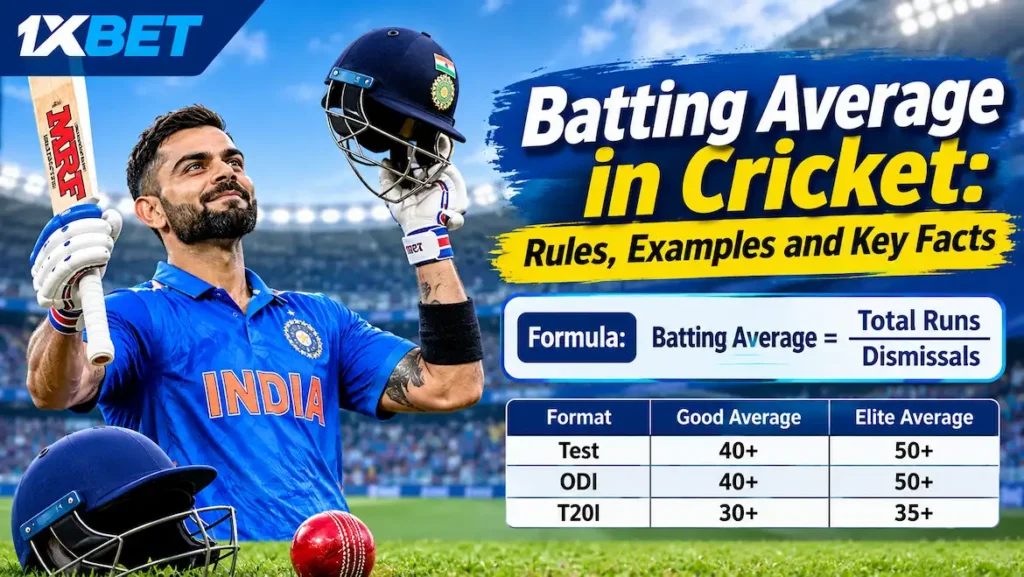
Before an India match starts, you’ve probably seen it on the TV graphic: a batter’s name, and a number beside it. 52.3. 31.8. 44.0. That number is the batting average in cricket, and it tells you how many runs a player usually scores before getting out. At 1xBet India, we want you to read that graphic the way a analyst does, so here’s the full picture in easy manner.
What Is Batting Average in Cricket?
Batting average is a batter’s total runs divided by the number of times they’ve been dismissed. That’s it. The idea behind it is simple too: a batter who scores 100 and then gets out for 0 three times in a row isn’t as dependable as one who scores 40 every time.

- It’s used in Tests, ODIs, T20Is and leagues like the IPL
- A higher average means more runs per dismissal
- Selectors, commentators and fans all lean on it to judge player performance
- Official records are maintained by the ICC and tracked on sites like ESPNcricinfo
It’s a cricket terminology staple, and once you understand it, scorecards start making a lot more sense.
Also Read: Strike Rate in Cricket: Formula, Rules & Examples
Batting Average in Cricket Explained: The Formula
You only need two numbers.
Batting Average = Total Runs ÷ Number of Dismissals
Example 1: Every innings ends in a dismissal
- Runs scored: 3,000
- Dismissals: 60
- Average: 3,000 ÷ 60 = 50.00
Example 2: Ten innings end not out
- Runs scored: 3,000
- Innings played: 60
- Dismissals: 50 (because 10 innings were not out)
- Average: 3,000 ÷ 50 = 60.00
Same runs, same innings, yet the average jumped by ten points. The reason is that a not out adds runs to the total without adding a dismissal. Most of the new fans miss this & it’s the main reason averages can look higher than you’d expect.
How Batting Average in Cricket Works: Not Outs, Retirements & Formats
The formula is very easy. What trips people up is deciding what counts as a dismissal. Here are the cricket rules that matter:
- Not out: Runs count, dismissal doesn’t
- Retired hurt: Recorded as not out, so the average stays safe
- Retired out: Recorded as a dismissal, so the average drops
- Innings that end early: If rain, a declaration or a won chase stops play with the batter still at the crease, then it’s a not out
- Format differences: Test batters have days to bat. T20 batters have a few overs and swing hard, so their averages are naturally lower
Because these rules are the same for everyone, therefore, you can simply compare players fairly, at least within the same format.
Also Read: Net Run Rate in Cricket: Rules, Formula & Examples
Batting Average vs Strike Rate: What Is the Difference?
These two get mixed up all the time, but they answer different questions which we have discussed below:
- Batting average tells you how many runs a batter scores per dismissal. Moreover, it’s about consistency.
- Strike rate simply tells you how many runs a batter scores per 100 balls. It’s about speed
Picture two batters. One averages 50 with a strike rate of 70. He’ll hold an end up all day. The other averages 28 with a strike rate of 160. He’ll score fast, get out often, and still win you a T20 game. Neither is better. They just do different jobs. We’ve covered the second stat in our guide on Strike Rate in Cricket, so give that a read next.
What Counts as a Good Batting Average in Cricket in Test, ODI and T20 Cricket?
It depends entirely on the format. Here’s a rough guide for match analysis:
| Format | Good Average | Elite Average |
| Test | 40+ | 50+ |
| ODI | 40+ | 50+ |
| T20I | 30+ | 35+ |
- Don Bradman finished his Test career on 99.94, which is still the highest ever. In addition, he needed just 4 runs in his last innings in order to reach an even 100 & was out for a duck
- Virat Kohli has held an ODI average well above 55 for years, a figure that a very few batters in history can match
- Career numbers move after every innings, so you should check ESPNcricinfo or the ICC site for current figures
In addition, keep in mind that pitch, era & opposition all affect these numbers. A 45 on a seaming pitch abroad can be more impressive than a 55 at a flat home ground.
Why Batting Average in Cricket Matters for Match Analysis
At 1xBet India, we think the best fans are the informed ones. If you follow matches closely, batting average gives you a quick way in order to size up a situation.
- Form: Compare a player’s last ten innings with his career average. Is he rising or slipping?
- Venue: Someone who averages 60 at one ground and 25 at another is showing you how conditions affect him
- Matchups: Look at how he fares against a particular team, or against pace and spin
- Team balance: A top order full of high averages usually gives a side a steadier base
- Pressure: Averages in chases or second innings can hint at how a batter handles the big moments
There’s a catch, though. Average says nothing about how fast the runs came, and a few innings can paint a false picture. Use it alongside strike rate and current form.
Common Mistakes When Reading Batting Averages
- Forgetting about not outs. A batter with lots of them can have a flattering average
- Comparing across formats. A 35 in T20Is and a 35 in Tests are two very different things
- Trusting a tiny sample. Five innings prove very little. A hundred prove a lot
- Ignoring context. Pitch, weather, bowling attack and match situation all shape the runs
- Leaning on one stat. Average alone never tells the whole story
How 1xBet India Helps You Follow Cricket Better
Understanding the numbers is the first step for enjoying the game more. Therefore, 1xBet India publishes clear cricket guides built around the rules, terms & stats fans search for most.
- Plain explanations with no confusing jargon
- Worked examples you can apply to any scorecard
- Content based on official ICC playing conditions
- A growing library covering LBW, DRS, Net Run Rate, Strike Rate and more
Whether you’re just getting into cricket or you’ve followed it for years, we aim to make every stat easy to understand & easy to use.
Conclusion
You now understand how batting average in cricket works, from the basic formula to not out rules, format benchmarks & smart ways to use it in match analysis. Moreover, pair it with strike rate and recent form & every scorecard will tell you a clearer story. Keep exploring more cricket rules guides on 1xBet India in order to build your knowledge of the game. This content is intended for readers aged 18 & above, so please follow responsible gaming practices at all times.